What began in 1901 as a professional society for insurance practitioners has grown into one of the most respected insurance and risk management programs in the world. Today, the Greenberg School stands as a global center for education, research, and engagement with one of the oldest and most resilient industries. Its undergraduate and graduate programs perpetuate the legacy of academic rigor and real-world relevance its founders set out to create.
As GSRM approaches its 125th anniversary, the milestone offers an opportunity to reflect on the school’s influence on the industry it serves. It is also a moment to celebrate the role the Greenberg School continues to play within the Peter J. Tobin College of Business, from industry partnerships and experiential learning opportunities to research that help shape the future of risk management.
From Professional Society to Global Academic Leader
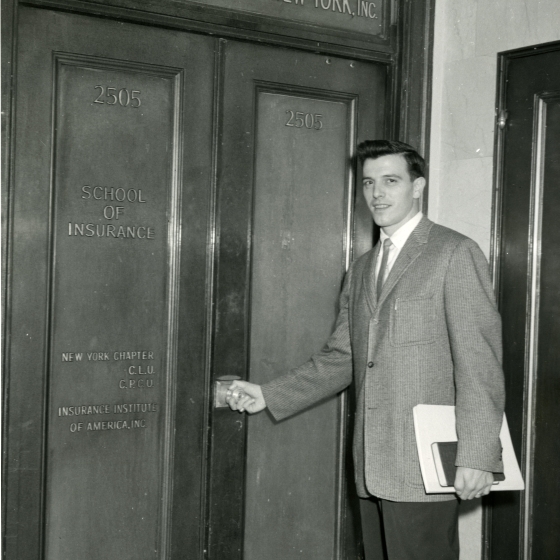
Entrance to the School of Insurance, c. 1950.
The origins of the Greenberg School date back to 1901, when insurance professionals Samuel P. Blagden and Robert P. Barbour founded the Insurance Society of New York (ISNY). At the time, the insurance industry was expanding rapidly and becoming increasingly complex. The founders envisioned a place where professionals could exchange ideas, access educational resources, and deepen their understanding of the field.
Early offerings consisted of lectures, discussions, and a reference library designed to help practitioners sharpen their expertise. As the industry evolved, so did the institution.
By the 1940s, formal courses were introduced to prepare professionals for credentialing and licensing exams. In 1946, recognition from the New York State Board of Regents allowed the organization to confer diplomas, marking an important step toward becoming a degree-granting institution.
That transformation culminated in 1962, when the organization formally became the College of Insurance, solidifying its role as a leading academic institution dedicated to risk and insurance education.
For decades, the College of Insurance educated industry leaders while maintaining close ties to practitioners who taught courses and mentored students. This integration of theory and real-world expertise remains a defining feature of the Greenberg School today.
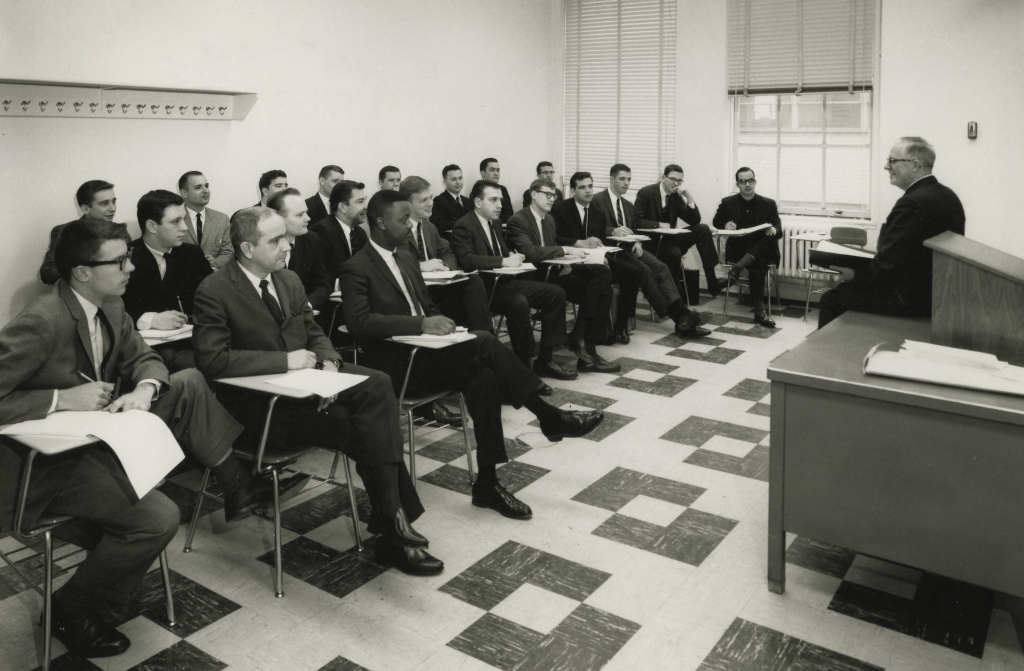
Inside the classroom at the College of Insurance, 1960s.
A New Chapter at St. John’s University
A pivotal moment arrived in 2001, when the College of Insurance joined St. John’s University, becoming part of what is now the Peter J. Tobin College of Business.
“One of the most remarkable things about the Greenberg School is the sense of community that exists between students, faculty, and the industry,” said Maureen Furlong Weber, Director of the Maurice R. Greenberg School of Risk Management, Insurance, and Actuarial Science, who has worked with the school for more than three decades. “Over the years, I’ve seen generations of students come through our programs and go on to become leaders across the insurance and risk management profession. That connection between education and industry is what has always set this school apart.”
The merger brought together deep industry expertise with the global reach and academic resources of St. John’s. It also laid the foundation for interdisciplinary programs connecting risk management with finance, analytics, and business.
In 2020, the school was renamed the Maurice R. Greenberg School of Risk Management, Insurance, and Actuarial Science, honoring the influential industry leader whose support helped strengthen the program’s impact and visibility.
Today, GSRM remains a leader among a growing number of programs at U.S. colleges and universities focused on encouraging potential and current industry employees to embrace the opportunities an undergraduate or graduate degree that the Greenberg School provides.
Expanding the Frontiers of Risk Education
Over the past decade, GSRM has continued to evolve in response to a rapidly changing risk landscape.
Academic programs have expanded to include areas such as enterprise risk management, risk analytics, and actuarial science, preparing students to address complex global challenges ranging from financial instability to cyber threats and climate risk. Building on this momentum, the school has introduced new coursework such as The Impact of Artificial Intelligence on Insurance—one of the first courses of its kind in the country—a deep dive into how AI is transforming underwriting, claims, distribution, risk modeling, and the broader insurance value chain.
Enrollment in the Bachelor of Science in Actuarial Science doubled in the early 2010s following the school’s designation as a Center for Actuarial Excellence by the Society of Actuaries.
The school also introduced the Quantitative Risk and Insurance (QRI) track, combining insurance education with data analytics to prepare students for increasingly data-driven roles in underwriting, brokerage, and claims analysis.
Uniting experts across disciplines, they examine real-world challenges and generate evidence-based insights through conferences, seminars, and publications. Their work informs policy and practice while helping communities, businesses, and governments navigate risk with greater clarity and resilience.
A Campus in the Heart of the Industry
For much of its history, the school’s location placed students at the center of the insurance industry.
Prior to joining St. John’s, the College of Insurance operated from 101 Murray Street in Lower Manhattan, a building constructed in the early 1980s with industry support. The location offered students direct proximity to many of the firms shaping the global insurance marketplace.
Situated among leading institutions such as New York University and The Cooper Union, the Astor Place campus reinforces the Greenberg School’s role within New York City’s academic and financial services industry.
Preparing Students for the Future of Risk
Beyond academics, the Greenberg School has built a strong reputation for preparing students for careers in one of the most resilient sectors of the global economy.
The Ellen Thrower Center for Apprenticeship and Career Services, established in 2010, plays a central role in this mission. Named for former College of Insurance President and the School’s first Executive Director, Ellen Thrower, the center connects students with internships, apprenticeships, and full-time opportunities across the insurance and risk management sector.
Students across the Greenberg School are already putting this preparation into practice through internships, leadership opportunities, and industry engagement.
“I chose the Greenberg School because of its strong reputation in both the insurance industry and academia,” said Anel Kurbanova ’26MS, who studied Enterprise Risk Management. “The program blends strategy, risk management, and entrepreneurship in a way that creates a practical foundation. My internship in Starr Insurance’s Enterprise Risk Management department feels like a natural extension of what I learned in the classroom.”
“What stood out to me about the Greenberg School was how dedicated the faculty and staff are to preparing students for their careers,” said Angelina Vereshchagina ’28TCB, an Actuarial Science student and incoming President of the Gamma Iota Sigma Alpha Iota Chapter. “Because the program is accredited by the Society of Actuaries, some of my coursework counts toward professional exams, which helps balance academics with leadership and internship opportunities.”
Industry partnerships remain essential to the school’s model. Executives frequently serve as guest lecturers, mentors, and members on one of three advisory boards – Overseers, Alumni, and Executive - ensuring that curriculum and training remain closely aligned with industry needs.
Scholarships and financial aid also play a critical role in supporting the next generation of risk professionals. The annual Insurance Leader of the Year Award Dinner (ILOTY) remains one of the school’s most important traditions. This year’s event raised $3.7 million for GSRM students, expanding scholarship opportunities and strengthening access to careers in the risk and insurance industry.
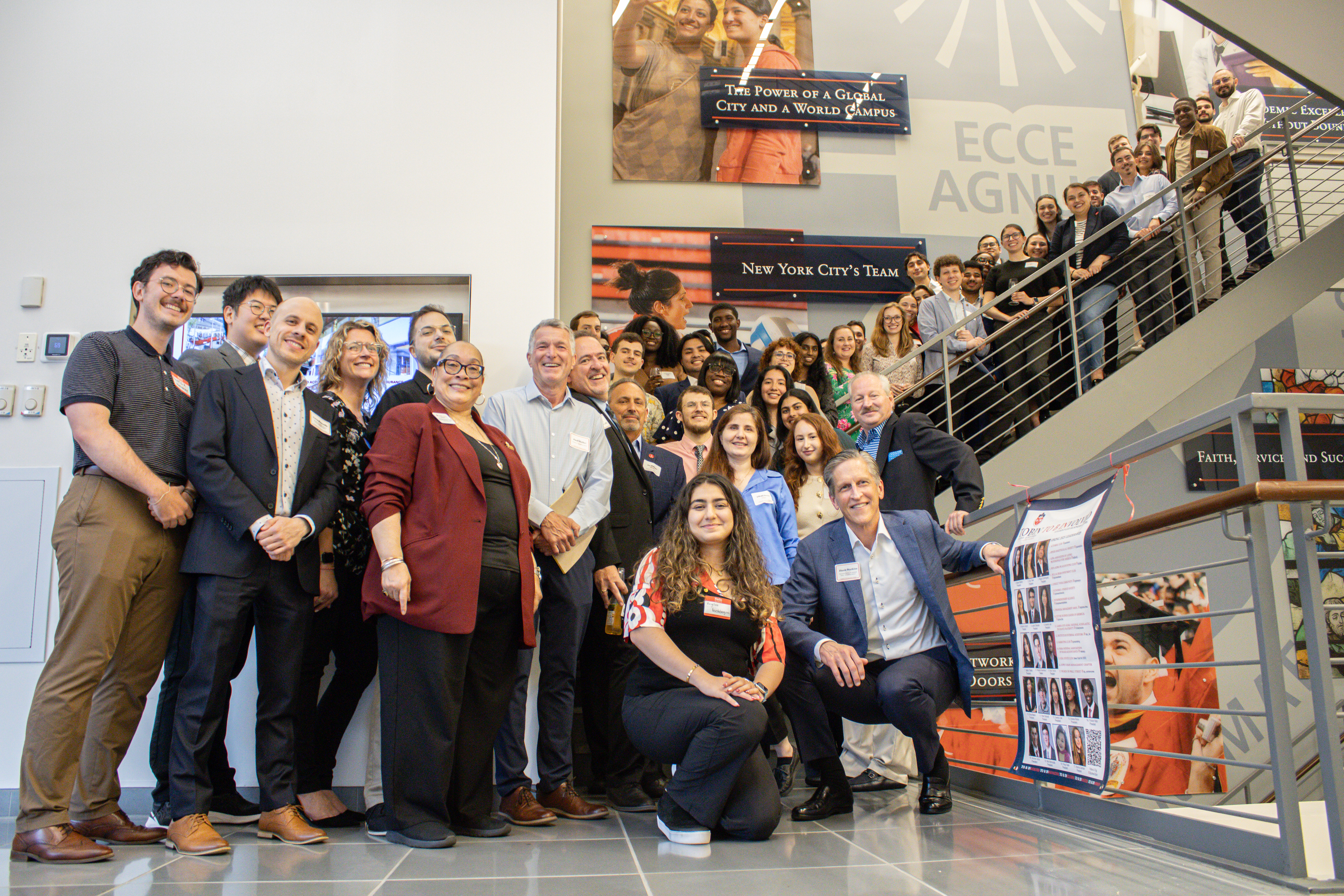
Alumni reconnect to celebrate community, tradition and shared legacy at the GSRM All-Class Reunion, 2025.
Looking Ahead
As risk management becomes an increasingly important skill set for organizations around the world, the Greenberg School’s will continue to provide students with the opportunity to seek meaningful roles in careers designed to mitigate risk while supporting growth.
As Hank Watkins, Executive Director and Associate Dean of GSRM, notes, “Assessing and managing risk has never been more central to the successful operation of businesses and organizations. For 125 years, our administration, faculty, and industry stakeholders have prepared students to embrace the challenges created by uncertainty and seek solutions that preserve enterprise value. Our commitment at the Greenberg School to convening academia and industry around successful student outcomes is as strong today as it was in 1901.”
From cyber threats and geopolitical conflict to climate change and global supply chain disruption, the challenges facing today’s leaders require professionals who can assess and mitigate risks that investors and other stakeholders expect to be managed.
For 125 years, the Greenberg School has helped define the risk profession. Now, it continues to shape what risk education can be, preparing the next generation of leaders for the uncertainties of tomorrow.
St. John’s University students had a unique opportunity to draw on the experiences of a former investment banking titan recently when Lloyd Blankfein , former Chairman and Chief Executive Officer (CEO...
Heather C. Robertson, Ph.D., LMHC, CASAC, CRC, Professor and Chair of the Counselor Education Department, has been selected as the 2026–2027 Scholar‑in‑Residence for the Center for Faculty Success and...
St. John’s University’s Maurice R. Greenberg School of Risk Management, Insurance and Actuarial Science, part of The Peter J. Tobin College of Business, will honor The Hartford’s Chairman and CEO...