

September 15, 2025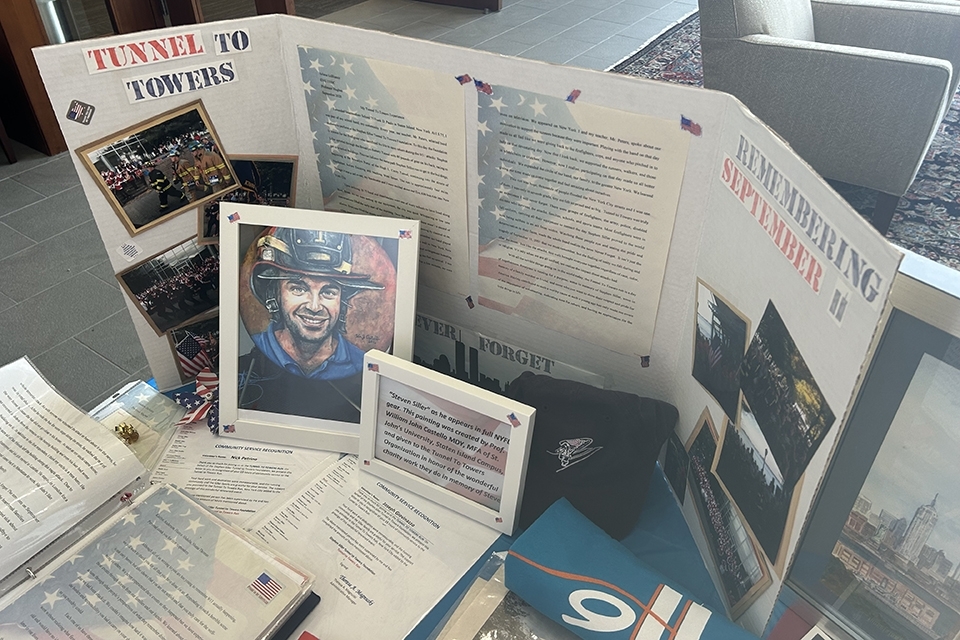
A display of student reflections, curated over 13 years by retired Adjunct Professor Paulette Hughes, served as the centerpiece of St. John’s University’s observance of the 24th anniversary of the September 11, 2001, attack on the United States.
Displayed in the first-floor lobby of the D’Angelo Center on Thursday, September 11, 2025, the exhibit told the story of 9/11 and its aftermath from the perspective of those in Professor Hughes’ classes from 2011 to 2024, when she retired.
Some of the earlier essays reflected students’ firsthand memories, while others—written by students born after the attack—honored the nearly 3,000 people who died, including 441 first-responders. Professor Hughes assigned the essays annually for students in her Discover New York, Global Literature, and Liberal Studies classes, and preserved them for annual display at the Staten Island, NY, campus.
Professor Hughes was delighted to bring the display to the Queens, NY, campus for the first time.
“It was a difficult day, but I would like us to remember how we all helped each other to heal,” she said. “That outpouring of love and kindness was something we needed.”
Professor Hughes’ project began on the 10th anniversary of the 9/11 tragedy, when she asked her students to write down where they were on that fateful day. Many students in that first class were in third or fourth grade but wrote powerfully of their recollections.
Over the years, the project grew as student submissions became more elaborate. Some evolved into poster and artwork submissions; others included newspaper clippings from the period. Student-made dioramas documented the story of Thunder Dog, a guide dog who helped his blind owner and others escape the North Tower; and Stephen Siller, a New York City firefighter whose death that day inspired his family to establish the Tunnel to Towers Foundation.
“It really is a tribute to my students,” Professor Hughes said. “Each year, I offered them a few options in the assignment, and they just ran with it. It blossomed and grew every year.”
The display, which attracted students and employees throughout the day, also included books related to 9/11, curated over the years by Professor Hughes and her students. The books tell the story of the day’s horror, and the heroism demonstrated by Fire Department of New York, New York Police Department, and Port Authority Police Department members.
“It was a day when we saw the worst of humanity, but also the best,” said Leticia Romero, Associate Director of Equity and Inclusion, Office of Multicultural Affairs, who helped bring the display to the Queens campus. “We should never forget their courage. Many of our current students were not born yet, but the connection to 9/11 is everywhere.”
Among the most poignant student reflections came from Rosina D’Amato ’18TCB, whose 2014 essay recalled her father’s anguish at returning to their home on Staten Island. Her father had earlier survived the 1993 attack on the World Trade Center.
“He just sat on the stoop, unable to fathom all that crumbled in front of his eyes,” Ms. D’Amato wrote. “But I was beyond blessed to still have my dad.”
Likewise, Anthony Fauzzi ’22Ed, ’23GEd wrote of his family’s anxiety over Anthony’s uncle, who worked in a restaurant near Ground Zero. After hours of uncertainty, his uncle returned home, “and our entire family slept in one apartment of a three-family house, just to feel safe and to share our love for each other,” Mr. Fauzzi recalled.
A 2018 essay by Daria Semisynova ’21TCB, ’22MS described 9/11 from the vantage point of an international student who had never visited Ground Zero until Professor Hughes’ assignment. “I read the letters people left for their loved ones at the National September 11 Memorial and Museum, and it broke my heart,” wrote Ms. Semisynova, who was born in Russia.
Ariana LoBianco ’23CCPS, ’24MS wrote meaningfully about her involvement in 9/11-related charities, including the Tunnel to Towers Foundation, which supports the families of fallen 9/11 first responders and military veterans. Its annual five-kilometer run and walk this year will be held on September 28.
“It is a day of togetherness, for a purpose,” Ms. LoBianco wrote, of the run and walk. “Having contributed to such a worthy cause has made me aware of the importance of volunteerism.”
Students visiting the display, including graduate student Aidan Heffernan ’25C —whose father is a retired New York City firefighter—were moved by the students’ stories.
“My dad worked at Ground Zero during the recovery,” Aidan said. “He has shared his memories of that day with me. His heroism, and the heroism of all the first responders, inspires me to this day.”
The significance of 9/11 was also remembered at the two daily Masses at St. Thomas More Church, and at an Office of Mission Initiatives-sponsored walking tour of the principle 9/11 memorials on the Queens campus. One such memorial is an embedded, cross-welded piece of salvaged iron from the World Trade Center site, featuring two cascading waterfalls and granite shafts designed to resemble the fallen Twin Towers. The shrine stands as a lasting monument to victims of the attacks that day—among them, Thomas More Brennan, a son of the church’s patrons, the late John V. Brennan ’63C, ’66L, ’93HON and his late wife, Anita.
Celebrating the 8 a.m. Mass, University Chaplain Rev. Hugo Medellín, C.M. ’05C told the congregation how the New Testament readings for the day—from the Gospel of Luke and St. Paul’s Letter to the Colossians—challenge Christians to “remove malice from your heart and focus on love.”
“If we are ever going to change the world, it will be through love,” Fr. Medellín said.