

January 29, 2026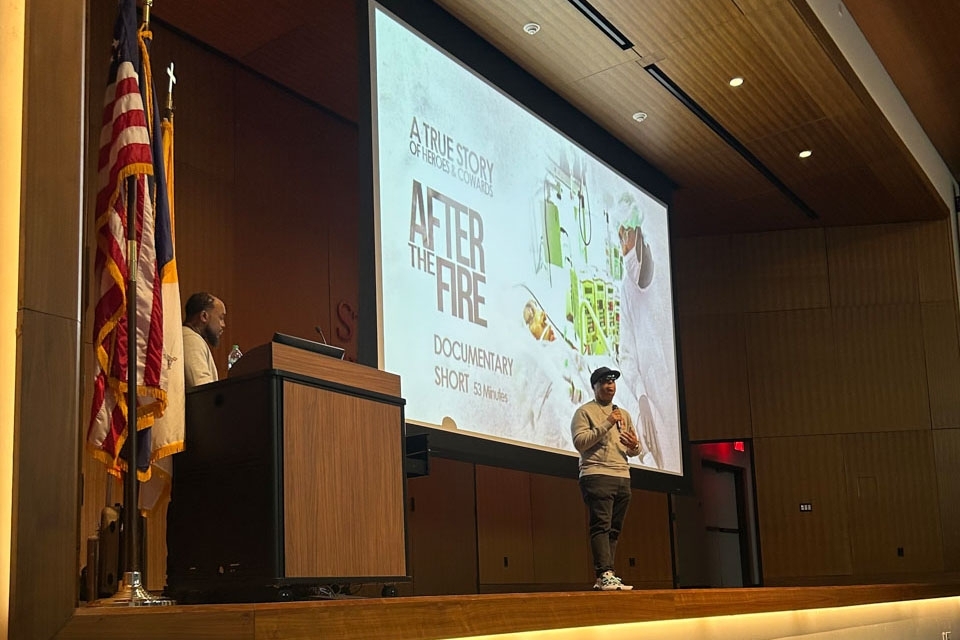
Two survivors of a tragic residence hall fire at Seton Hall University more than a quarter-century ago brought a message of preparedness and prevention to St. John’s University on January 20.
Alvaro Llanos and Shawn Simons, first-year roommates at Seton Hall’s East Orange, NJ, campus in 2000, spoke to 90 resident assistants and Office of Residence Life staff nearly 26 years to the day of the fire that killed three students and injured 58.
“They drove home how important vigilance is,” said Jason T. Bartlett, Ph.D., Director of Residence Life at St. John’s. “An ounce of prevention is worth a pound of suffering later on.”
“Their message to every student was, when you move into your residence hall, look left and right, find out where the exits are, and count the number of doors between you and an emergency exit,” Dr. Bartlett added.
The Seton Hall fire, which began as a student prank, quickly accelerated when it contacted a couch made of flammable polyurethane foam. Within minutes, the lounge became an inferno with temperatures reaching 1,500 degrees.
A lack of sprinklers in the residence hall allowed the fire to spread unchecked, while the burning synthetic materials created thick smoke that filled the hallways, making it nearly impossible for students to see or breathe as they attempted to escape.
Mr. Llanos and Mr. Simons, both of whom eventually graduated from Seton Hall, have become fire safety advocates and motivational speakers who have addressed several hundred colleges and universities since the January 19, 2000, tragedy. Mr. Llanos suffered burns to 60 percent of his body; Mr. Simons sustained burns to 16 percent of his body. Both survived after spending several weeks in medically induced comas.
Mr. Llanos and Mr. Simons made their first visit to St. John’s since before the COVID-19 pandemic.
“Because of what happened to us at Seton Hall, we began to think, ‘What can we do to make sure this never happens again?’” Mr. Simons said. “We were always impressed by the care St. John’s showed for the students in its residence halls.”
Mr. Llanos and Mr. Simons began their advocacy work three years after the Seton Hall fire with a talk at Montclair State University in New Jersey. The effort picked up speed in 2010 with the publication of the book After the Fire: A True Story of Friendship & Survival by The Star-Ledger reporter Robin Gaby Fisher. A documentary, After the Fire: A True Story of Heroes & Cowards, followed in 2011.
Mr. Llanos, who planned to major in computer science, and Mr. Simons, a business student, pivoted to advocacy work upon their recovery. With their help, New Jersey enacted a mandatory residence hall sprinkler law and the federal government required that all colleges and universities publish an annual fire safety report. Other states, including Delaware, Illinois, New York, Pennsylvania, Wisconsin, and Wyoming, also enacted stricter regulations for campus housing. Polyurethane foam in furniture is now generally restricted in college residence halls.
“If measures such as those we advocate for had been in place that night, maybe it could have saved us from being injured or possibly saved our classmates who lost their lives,” Mr. Simons said.
The Marillac Hall Auditorium audience consisted mainly of St. John’s resident assistants (RA)—full-time students who act as mentors, enforce housing policies, connect resident students with campus resources, and more. They often live on the residence halls floors they manage, acting as a primary, accessible contact for students.
Resident assistants are selected from a large pool of applicants and are interviewed by Residence Life staff. Prior to selection, RAs attend informational sessions; once chosen, they undergo two weeks of training and participate in monthly refresher courses. They also host monthly floor meetings with the residents of their floors.
“Listening to someone who had a real-life experience of this nature was a great lesson,” said junior Sydney Whitehall, an RA on the fifth floor of DaSilva Hall. “We do not want any of the residents to experience what they did. We need to speak about these things to help prevent them from happening again.”
“It is important to have conversations like this, especially with residents in a first-year building,” added senior Jolie Barreto, an RA in Donovan Hall. “For the most part, our residents take the safety protocols seriously, but the story Alvaro and Shawn shared inspires us to take fire safety even more seriously.”
Mr. Llanos and Mr. Simons delivered a powerful message about the need to prepare for potential emergencies. In particular, they reminded St. John’s RAs to
- Instruct residents on all available exits in case of fire;
- Have meaningful conversations with residents about potential hazards; and
- Remain vigilant and always act as floor leaders.
The discussion also included a screening of the 2011 documentary, available on the Fox Corporation’s free streaming platform Tubi.
“The RAs are probably the most responsible students living inside the residence halls,” Mr. Simons said. “They need to communicate with the students they are responsible for. It is a vital role. If they see any violation or a safety risk, they must report it. It could be a life-or-death situation.”
Sydney, who supervises 40 undergraduate residents of all grade years, agreed. “I tell each resident they must remember they are not the only person that has a life to live here,” she said. “Considering others is a big thing—when you protect yourself, you protect others.”