

November 4, 2026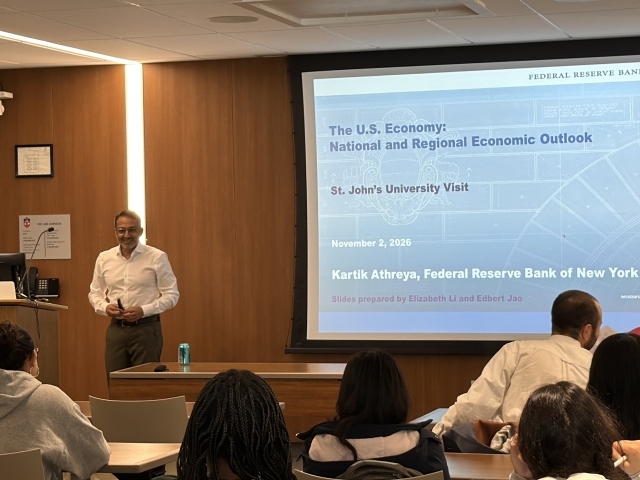
What can national economic data tell us about Americans’ financial well-being—and what might those numbers leave out?
That question helped frame a conversation with Kartik B. Athreya, Director of Research and Head of the Research and Statistics Group at the Federal Reserve Bank of New York, during his November 2 visit to St. John’s University’s Peter J. Tobin College of Business.
Speaking in Munson Lecture Hall on the Queens campus, Athreya connected concepts from economics and finance courses to questions about inflation, housing affordability, artificial intelligence, and the labor market. Throughout the discussion, he invited students to offer explanations, challenge assumptions, and consider the trade-offs facing policymakers.
His central message: a broadly resilient economy can coexist with financial hardship for many households.
Athreya described an economy in which overall growth and employment remained relatively healthy, while inflation continued to warrant policymakers’ attention. He encouraged students to look beyond national averages to understand how economic conditions affect people differently, depending on their income, age, assets, and expenses.
During a question about affordability, he pointed to housing as an example. Rising housing costs can place a disproportionate burden on lower-income households, which often devote a larger share of their income to rent or homeownership. Addressing that challenge, he explained, requires attention to housing supply and land use, alongside an understanding of interest rates.
The exchange illustrated a distinction that Athreya returned to throughout the talk: the difference between changes in the price of a particular good or service and changes in the overall price level. Monetary policy can influence inflation, he explained, but it cannot resolve every underlying issue that makes an essential expense more costly.
Athreya also walked students through the Federal Reserve’s dual mandate of maximum employment and stable prices. The balance between those objectives depends on economic conditions, he said. Supply disruptions can make that task especially difficult by putting upward pressure on prices while weakening economic activity.
Rather than presenting those decisions as abstract policy questions, Athreya repeatedly brought the discussion back to familiar choices. He explained why households generally try to maintain their lifestyles through financial uncertainty, while businesses may postpone investments until conditions become clearer.
“Investment comes with the real option to wait,” he said, connecting a finance concept to the broader behavior of the economy.
Students helped shape the conversation through questions about artificial intelligence, housing costs, government debt, and Treasury securities.
Asked whether AI could transform economic growth and productivity, Athreya offered historical perspective. Major innovations, including electricity and computers, have reshaped the economy, but their benefits have taken time to spread as organizations changed how they worked. AI’s potential is substantial, he explained, while its ultimate effects on productivity and employment remain uncertain.
The conversation also offered students a closer look at careers within the Federal Reserve.
Athreya described the Federal Reserve as a place where intellectual curiosity drives research across areas including household finance, inequality, financial markets, and monetary policy. He emphasized the importance of understanding how different parts of the economy work together to inform policy decisions.
He encouraged students interested in economics to explore research assistant opportunities, which can provide experience supporting economists and help graduates determine whether they want to pursue further study. He also highlighted opportunities in analytics, finance, data science, accounting, and bank supervision.
For Tobin students, the discussion offered more than a look at economic policymaking. It demonstrated how the concepts they study in the classroom inform decisions that affect households, businesses, and financial markets across the country.