
October 1, 2026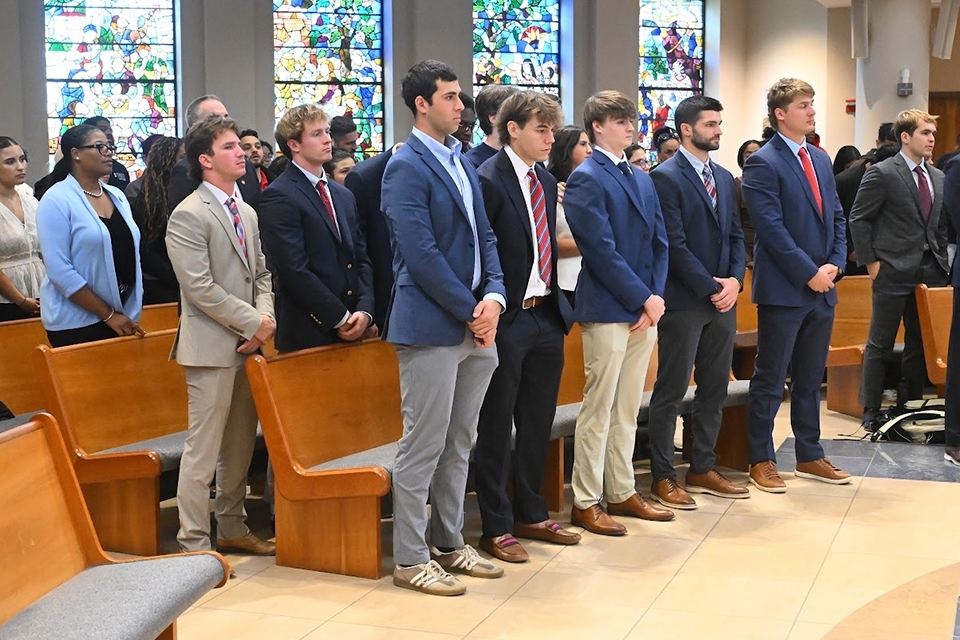
St. John’s University’s annual Founder’s Week celebration centered on healing in all its forms. Lectures, Masses, and gatherings held from September 21 through 28 emphasized the need not only to provide healing, but to truly understand those who need it and draw close to them through direct, empathetic service.
Founder’s Week was created to encourage the University community to reflect upon its Vincentian identity and find contemporary expressions of St. Vincent de Paul’s legacy. Events included the Faculty Research Luncheon, Administrators and Staff Luncheon, Vincentian Convocation, Mass for the Solemnity of St. Vincent de Paul, and Vincentian Heritage Lecture. University Service Day was canceled due to inclement weather.
Reflecting on the week, the Rev. Patrick Griffin, C.M. ’13HON, Executive Director of the Vincentian Center for Church and Society, said the theme, “Be Vincentian: Be a Healer” reflected a central dimension of St. Vincent de Paul’s ministry.
“St. Vincent de Paul was a man who practiced the power of healing throughout his ministry,” Fr. Griffin said. “For him, it touched on each aspect of the human person from body to mind to spirit. During this Founder’s Week, the University community held up the importance of this virtuous activity in our lectures, liturgy, and labor.”
He added that Jesus offered “life-giving care” through his service to others and that St. Vincent followed that example. “It is a blessing that our Catholic and Vincentian institution can take up that same practice across our academic and social environment.”
The Faculty Research Luncheon, held on September 22 in the D’Angelo Center on the Queens, NY, campus, recognized faculty award recipients, while the Administrators and Staff Luncheon, held the next day in the same location, featured Jonathan W. Dator, Ph.D., Director of Counseling and Psychological Services, as the keynote speaker.
Dr. Dator described counseling not as a peripheral University service, but as an expression of Vincentian direct service. Drawing from his own experience of losing most of his eyesight while in college, he emphasized the importance of ensuring students receive help before a crisis derails their education.
“When we think about the Vincentian mission and what it means to be Vincentian, that’s what it is—community-based work,” Dr. Dator said. “That is important to what we do in the counseling center: direct service. This is not just handing out referrals, just like helping the poor is not just handing out a check. It is direct service to the community.”
During his homily at the Solemnity Mass held on September 25 in St. Thomas More Church, the Rev. Aidan R. Rooney, C.M., M.Div., M.Th. ’78NDC, Executive Vice President for Mission, focused on the Beatitudes and the notion of “holy integration,” a refusal to separate prayer, work, study, and service into unrelated compartments.
The Beatitudes overturn ordinary definitions of success, Fr. Rooney stressed. “God tells us that the poor, the sorrowful, the lowly, and the peacemakers are the ones who are truly blessed.” Holy integration, he explained, is not living for God and Jesus just on Sunday, but living for God and Jesus in every moment of our lives.
He added, “Vincent understood the Beatitudes perfectly because he knew that hungering and thirsting for holiness meant not only seeking God in prayer, but seeking God in the hurt flesh of the poorest of the poor.”
Fr. Rooney observed that St. Vincent de Paul possessed that rare, beautiful gift of putting two parts of his life together: a profound life of prayer and tireless service of the neighbor, “because he knew both were somehow bound up in God’s offer of salvation in Jesus Christ. Vincent can be, for each of us, the perfect example of this balance.”
At Mass, student leaders from across campus were commissioned to share in the University’s mission of service and leadership.
Fifth-year Pharmacy student Philip Marbid, a President’s Society member, Catholic Scholar, and cantor at St. Thomas More Church, tied leadership directly to service. “For me, what is important is leadership by example. Servant leadership is very much a part of the culture here, where you never stand so tall as when you bend the knee to help another.”
Riley Horan, a junior and member of the St. John’s Dance team, emphasized that being a leader means a great deal to her. “A good leader is strong and understanding, but also confident and with good moral character. As members of the Dance team, we always look for opportunities where we can serve and how, to the best of our abilities, we can help as many people as we can.”
The Vincentian Heritage Lecture, held on September 28 in the Belson Moot Courtroom in the School of Law, capped off Founder’s Week and was presented by M. Therese Lysaught, Ph.D., Rose F. Kennedy Chair in Christian Ethics at Georgetown University.
Entitled, “Knowing the Impoverished: Poverty, Race, Ethnicity, and Catholic Bioethics,” Dr. Lysaught used maps as her cornerstone analogy for what Catholic bioethics have and have not emphasized over the years.
Maps help people understand reality, Dr. Lysaught argued, but what a map excludes can be just as significant as what it includes. She contended that the discipline has extensively mapped questions such as abortion, contraception, assisted suicide, genetics, and conscience, while devoting comparatively little attention to poverty, race, ethnicity, and the social conditions shaping health.
Catholic bioethics has, for the most part, “failed to know the impoverished,” and she drew a distinct line between knowing the impoverished and simply serving them.
Dr. Lysaught discussed the story of Sister Mary Stella Simpson, D.C., whose midwifery training among impoverished Hispanic families brought her to a deeper understanding of those she served, enabling her to become a pioneering force in this arena.
Sr. Mary Stella learned to enter patients’ homes on their terms: to knock, wait for permission, listen, and understand the practical circumstances of their lives. That experience transformed her approach to maternity care.
“You can only act in the world that you can see,” Dr. Lysaught said.
Dr. Lysaught also pointed to the work of physician and medical anthropologist Paul Farmer, M.D., Ph.D., who spent decades working in Haiti and other underserved communities. Dr. Farmer argued that effective health care required more than providing medicine—it required understanding the social conditions that prevented patients from getting well.
“Both understood the heart of the Christian tradition,” she stressed, “that in the poor we meet Christ.”