

September 8, 2026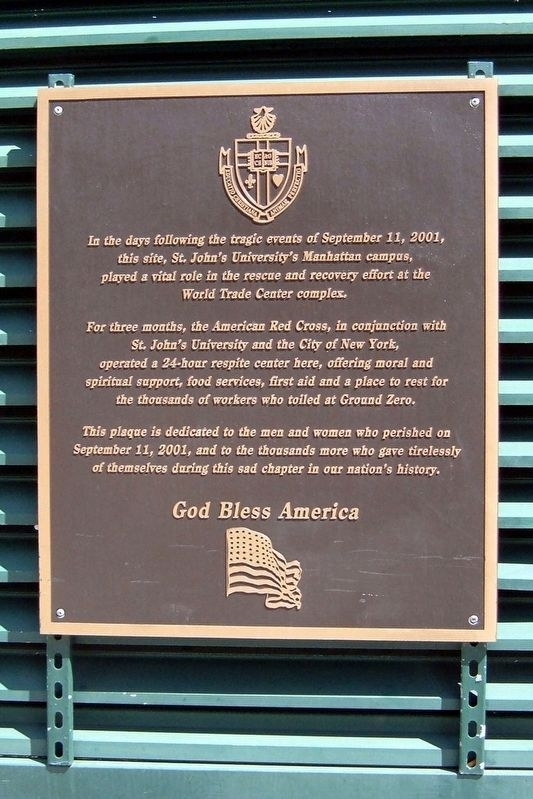
Memories from 9/11/01.
Twenty-five years later, members of the St. John’s University community reflect on their experiences from September 11, 2001, from a University perspective.
“September 11, 2001, was the day of the fall semester activities fair. The campus activities team was setting up on the Great Lawn, and I distinctly remember what a beautiful day it was, with the sun shining and a crystal-clear sky.
I had come back to the student life office in the University Center to grab some supplies, and I walked past one of the support staff who was trying to get the clock radio on her desk to tune into an a.m. news station. She said a family member had just called her and said a plane had gone into one of the World Trade Center buildings. Within minutes, most people’s phones were ringing, and we had turned on the large TV in the student lounge. We could see the aftermath of the plane crash, and then the horror of the building collapse.
I was with some of the closest people in my life at that moment, and the memory will stay with me forever.
By late morning, we got calls that students were walking from Manhattan across the 59th Street Bridge. The University had just purchased the College of Insurance just a few short weeks prior. The students who were in the building on Murray Street were immediately evacuated. All they knew was that they were now St. John’s students and wanted to make their way to 8000 Utopia Parkway.
The students showed up with just the clothes on their backs, covered in soot and in shock. We immediately set up a welcome center in Council Hall, providing them with food, water, a place to rest—but most importantly, the opportunity to call home, as many of these students were international. They were able to connect with family and let them know they were safe. We immediately found each student housing in the residence halls, providing clothing and other essentials, including bedding, towels, toiletries, textbooks, and other academic supplies, so that they could remain with us for at least the semester while emergency services took over the Manhattan campus.
It was the Vincentian spirit that rallied us during those immediate hours and days. It was by the grace of God that those students had a place to come to, and it gave us all purpose to help them. No one was immune to what was happening in their personal lives or to the effects of the horrific day as it unfolded. But, as a St. John’s community, with our focus on the well-being of the students in front of us, we leaned in and managed the tasks at hand to provide the very basics of needs, comfort, and compassion to our newest Johnnies.
St. John’s students should connect this lesson to our Vincentian tradition: How do we respond to tragedy with humanity, service, compassion, and care for others? The lasting lesson should not only be what happened to us, but also how people responded to one another. That gives students a way to understand September 11 that is historically grounded, personally meaningful, and connected to the kind of community we want St. John’s to be.”
—Jackie Lochrie ’94ED, ’99M.S.Ed., ’08P.D., ’24Ed.D.
Vice President for Student Affairs
“The day the attacks of September 11 took place, we had just started classes at the Rome campus. We were in our second week of the semester, and the graduate students and faculty had just started settling into a new city and country, experiencing the annoyance of jet lag and the excitement of this new adventure on which they had just embarked.
We were on campus (in Rome, it was early afternoon) and most students were already in the facility studying and preparing for evening classes. Likewise, some of the professors were there, finalizing and polishing their evening lectures. I remember some students rushing into the office to let us know what they had just seen on TV while watching the news from the US. I recall joining the students in the classroom and the deafening silence as we all watched the events unfold in total disbelief. Some students were crying, others were angered. I remember one professor watching the screen in utter shock.
At the time, our internet connection was provided directly from our Queens campus, so we were completely cut off when it was severed. We could only talk to Queens on the phone when the call went through. Students could not communicate via the internet back home, with many of them from New York.
We were running around trying to manage the students’ emotions and having them call their loved ones. It was a shocking moment that impacted us all, despite the distance, because of the direct human and organizational connection we had with the home campus in Queens. It was a moment that bonded all those attending the Rome campus.”
—Massimiliano Tomassini, Ph.D. | Europe Campuses and Operations
Assistant Vice President, Europe Programs
St. John’s University Rome Location
“On September 11, 2001, I was getting ready to drop my son off at daycare before heading to St. John’s University. I remember seeing the plane crash into the towers on television, but I couldn’t believe what I was watching—it felt like a movie, not reality. When I arrived at the Residence Life office, my supervisor confirmed that it had happened.
We were all in shock. Soon after, about 10 students walked into our office, covered in thick dust and clutching plastic bags filled with whatever they had managed to grab. These were St. John’s students from the Manhattan campus, who had crossed the bridge on foot, frightened and in despair.
I remember we had to find places for them to stay, get them food and clothes, and most importantly, find a way for them to contact their families. We continued to support these students, and I remain deeply grateful that our department was able to help them through that traumatic experience in 2001.”
—Michelle H. McCullers | Division of Student Affairs
Associate Director of Residence Life
“I was on the Queens campus of St. John’s University when the attacks unfolded. I first learned something had happened through a call from my mother, who worked for New York State in Albany. She told me there were reports that a small plane had struck one of the World Trade Center towers. We immediately turned on the television in the Media Relations conference room and watched the events unfold in real time.
As the enormity of the tragedy became clear, shock and fear spread across campus. Many of my colleagues had family members who worked in the Twin Towers, and there was tremendous anxiety as people tried to contact loved ones.
The day felt especially personal for my family. My niece was on a ferry to the Statue of Liberty during a school trip and witnessed the tragic events unfold from New York Harbor. My husband was supposed to be in lower Manhattan for a photo shoot that day, but by the grace of God, it had been canceled.
Later that week, I learned that a friend I had met while studying in Italy had perished in the attack on the North Tower. That news brought home the reality that this was not just a national tragedy. It was deeply personal, touching people I knew, people my colleagues knew, and countless members of the St. John’s community.
At some point between the collapse of the first and second towers, a colleague and I walked to the fountain at the top of the Montgoris staircase. From there, we witnessed the collapse of the second tower. It is an image I will never forget. In a matter of hours, our city, our nation, and our St. John’s community were forever changed.
What I remember most is the overwhelming sadness and disbelief. We were sent home around noon that day, and life seemed to stop. Everywhere we turned, the attacks were on television. The images, the stories, and the search for survivors became part of our daily lives.
I also remember the eerie silence. Living so close to the airports, I was used to hearing planes overhead, but with commercial air traffic grounded, the skies were suddenly quiet. That silence was often broken by the sound of military jets patrolling New York City, a constant reminder that nothing was the same.
There was a heaviness over New York and across the St. John’s community. Nearly everyone knew someone who had been affected. Yet amid the grief, I witnessed extraordinary kindness, resilience, and unity. People took care of one another in ways I had never seen before.
Many of today’s students know September 11 through books, documentaries, and memorials. For those of us who lived through it, it was deeply personal. The attacks touched countless families, including many in the St. John’s community, and changed how we live, travel, and view the world.
What I hope students understand is not only the tragedy itself, but the resilience that followed. New Yorkers came together in remarkable ways, supporting one another and finding strength in community. St. John’s did the same when our Manhattan campus served as a respite center for emergency responders.
September 11 is a story of profound loss, but also of courage, compassion, and hope. As we mark the 25th anniversary, we must continue to honor those who lost their lives, remember the families forever changed by that day, and never forget the resilience and unity that emerged from one of the darkest moments in our nation’s history.”
—Nunziatina A. Manuli ’97M.B.A.
Vice President, Chief of Staff to the President, and University Secretary
“On September 11, 2001, I was a Graduate Assistant in Student Life and lived in O’Connor Hall. I was getting ready for work when I saw the news and thought I was watching a movie. I called the office, barely able to ask, ‘Is that really happening?’ I was told to come in immediately.
What I remember most in the days and weeks after is how quickly St. John’s mobilized, and how completely titles stopped mattering. Alumni Hall (now Carnesecca Arena) opened as a shelter within hours. Available beds were tracked across all residence halls in case students needed housing; students’ safety and well-being were checked, and donations were organized. Communication with Manhattan was cut off, which felt especially personal since our old Manhattan campus sat in the World Trade Center neighborhood. Despite fear and uncertainty, people showed up for one another as one community.
The thing I think today’s students should understand about 9/11 and its aftermath is that a crisis reveals who a community truly is. St. John’s answered that day with urgency and compassion, not procedure. The Vincentian mission was lived out in action, without instructions. People didn’t wait, but just helped.
Twenty-five years later, I still remember the disbelief in my voice that morning, and I remain grateful to have been part of the St. John’s family on that unforgettable day.”
—Rosa C. Yen ’03M.S.Ed., ’12M.A., ’21M.A.
Director of Multicultural Affairs
Office of Multicultural Affairs, Division of Student Affairs
Adjunct Professor, Department of Core Studies
“That horrid morning, I was sitting in the dining room of the Vincentian Community Residence at DePaul University when one of the confreres came in and told us that a plane had hit the World Trade Center. Immediately, the senior priests recalled the 1945 crash into the Empire State Building, and, rightly or wrongly, we dismissed it as a similar unfortunate accident, until another priest came in and told us there had been an additional crash. Panic set in, and all of us retreated to our common room to watch the tragedy unfold.
A silence pervaded that space of which I have never been a part. I am sure paralyzing thoughts raced through our minds: ‘That is New York. We are in Chicago. We are safe—or are we?’
I don’t know how many men went to work that day. My doctoral classes at Loyola were canceled, giving me the time to check in on family and friends back here in the metropolitan area. Little did any of us know that this event would become an epic in American history and resonate across the global village, impacting generations.
Admittedly, it was brutal for me to be distant from family and friends as the subsequent days unfolded. A key memory I have of the confreres at St. John’s University is that they made themselves available to anyone who just wanted to talk. Many of them went down to our former Manhattan campus on Murray Street.
The University community turned out en masse to support people they knew and did not know as local churches, synagogues, and mosques honored their dead and buried their beloved loved ones lost so quickly and tragically. Many of them did not know what to say or do in the face of such a confusing and apparent reality—but they showed up. Showing up, particularly in times of trouble, is what I remember most about St. John’s folks.
One of my assessments of our St. John’s students is that they live in the present and maximize their time (although technology can rob them of that). They were born into families who experienced the 9/11 tragedy; their families navigated the 2008 financial crisis; they have witnessed so many school shootings; they know terrorism is motivated by people unwilling to engage in or frustrated by civil discourse; and they endured the confining health crisis of COVID-19.
St. John’s students have ‘grit,’ and I truly believe that. They are constructed in a way that sets them apart and makes them ready to face any challenges that may come their way. At the same time, I hope we can teach our students to flourish in life and not be so tethered to technology. In so doing, they can grow in intimacy with each other and truly experience each other as neighbors. This will assist them when they must have those uncomfortable, healthy conversations that will advance their relationships and our common good.”
—Rev. Patrick S.L. Flanagan, C.M., Ph.D.
Chair and Associate Professor, Department of Theology and Religious Studies
St. John’s College of Liberal Arts and Sciences
Vice-Chair, University Board of Governors
St. John’s University
“I was in my office, which was then in Bent Hall. We had just started the semester on September 5th, so it was still busy that morning. Someone had heard that a plane had hit a Trade Center tower, and I immediately presumed it was a small plane. Just after that news, we heard about the second plane and the horrifying details. The University closed later that morning and when we went home, we immediately turned on the TV. I was reminded of how the shock of this was so much like what happened when President Kennedy was killed, and we were glued to the TV for many days thereafter.
What I most remember in the following days and weeks was a feeling of stunned shock and sadness when we learned about the number of victims, including many members of the extended University family. On some of those early days, we could even see and smell the smoke from the towers. And then there were the funerals. I hope that students today understand how precarious life can be.”
—Rev. Michael J. Cummins, C.M., M.Div., Th.M.,
The Lesley H. and William L. Collins College of Professional Studies
“I was working at St. John’s University’s Oakdale campus on September 11, 2001. I remember watching the news on the one television we had on campus as the first plane hit. It was difficult to comprehend what was happening and that it was an act of terrorism, especially because it felt so close to home. As I drove home that day, I remember making eye contact with the other drivers on the road. Without saying a word, we seemed to share a sense of shock, fear, and sympathy with one another.
What I remember most was how quiet everything was in the days that followed. With no planes flying, the skies were eerily silent. That silence was a constant reminder that something had changed. There was also a strong sense of togetherness among the St. John’s community as we tried to process what had happened and support one another.
I think today’s students should understand the sense of compassion that brought our campus community together following the attacks. We were all experiencing the same tragedy, and it created a sense of unity. September 11 was devastating, but it also reminded us of the importance of coming together, supporting one another, and showing kindness during difficult times.”
—Cheryl O’Hara ’01M.A.
Lead Integrated Marketing Strategist, Advancement
Marketing and Communications
Remembering 9/11: A Coach’s Reflection
“When I think back to September 11, 2001, the shock and sadness of that day immediately come to mind. As the head coach of the St. John’s Women’s Volleyball team, we were in the early part of our season, practicing and competing in the BIG EAST Conference.
But, suddenly, volleyball seemed so insignificant. I also quickly realized the responsibility I had for a team of young student-athletes at a time when none of us really knew what would happen next.
Our St. John’s volleyball team was made up of young women from the US and from countries around the world. Many were far away from their families, frightened and trying to understand something that none of us could truly comprehend. As their head coach, I knew they were looking to me for reassurance. My responsibility was to lead them, protect them as best I could, and somehow convince them—and maybe myself—that everything was going to be all right.
Not long after 9/11, we were scheduled to travel to Virginia Tech. Air travel had only recently resumed, and we had to board one of those early flights out of LaGuardia Airport on a US Airways plane.
I remember thinking to myself, US Airways. A plane with “US” in its name. After what had just happened, even something as simple as the name of an airline frightened me.
I will never forget walking through LaGuardia Airport with my team that morning. Our flight was early—around 9 a.m.—which made it even more unsettling because it was around the same time of morning that the attacks had occurred. We walked quietly through the terminals, almost trying to pretend that nothing was wrong. My players were incredibly brave and courageous. I am sure that many of us were silently praying as we waited to board.
LaGuardia, normally filled with thousands of people rushing from one place to another, was almost empty.
It was quiet. Eerily quiet.
There was a feeling in that airport that is difficult to describe even today. We were brave, but we were scared.
Then we boarded our US Airways flight. As that plane began to take off, I am sure many of us were thinking the same thing, but were afraid to say it aloud: Could our airplane be hijacked? Could our plane be next?
I was thinking it, too. But, I was the head coach.
My players were watching me, so I put on the bravest face I could. I tried to act as though everything was normal and going to be fine. That is sometimes what leadership requires. You can be frightened yourself, but when other people depend upon you, you somehow find the strength—and the faith—to keep moving forward.
For me, there was another layer to that fear.
Years earlier, when I was a student-athlete at Syracuse University, I experienced the tragedy of losing a teammate, Alexis Tsairis, in the bombing of Pan Am Flight 103 over Lockerbie, Scotland. That loss had never completely left me. So, as our St. John’s team climbed into the sky in the aftermath of 9/11, those memories came rushing back.
Yet, this is also where my experience at St. John’s University and my Catholic faith mattered so deeply. There is something very special about working at a Catholic and Vincentian university in moments when life gives us questions for which there are simply no easy answers. I could not promise my players that nothing bad would ever happen. I could not control what was happening in our country or in the world.
But, I could believe that we were not alone. I believed that Jesus was traveling with us on that airplane.
I knew our St. John’s community was praying for us and for one another. And I knew that thousands of other families and communities were doing the same thing—holding on to faith, holding on to each other, and trying to find the courage to move forward.
Looking back 25 years later, I think that may be one of the greatest lessons 9/11 taught me about coaching and leadership. Courage is not the absence of fear. Sometimes courage is being afraid and moving forward anyway because other people are counting on you.
My players showed tremendous courage. These were young women from different countries, cultures, backgrounds, and faith traditions, yet in that moment, none of those differences mattered. We were one team. We took care of one another.
Perhaps that is one of the lessons worth passing along to today’s St. John’s students. The world will give them moments they cannot prepare for. There will be uncertainty, loss, and fear. But, they do not have to face those moments alone. They have their faith, families, teammates, friends, and this extraordinary St. John’s community.
Twenty-five years later, I cannot tell you the scores of the matches we played that weekend, but I remember how connected we were on the court that weekend. It was as if we had to fight even harder because we all represented New York City. When we won that day, our team dedicated the victory to all the families who had lost loved ones on September 11.
In sports, we often talk about having to ‘play on.’ After 9/11, those words took on an entirely different meaning for me.
Playing on did not mean forgetting what had happened. It did not mean that the fear or sadness suddenly disappeared. It meant honoring those we had lost by finding the courage to continue—to get back on the plane, to step onto the court, to support one another, and to keep living.
That is what our young student-athletes did. That is what our St. John’s community did—and that is what our country was trying to do.
We were frightened. We prayed. We leaned on one another. Somehow, with faith, we found the courage to move forward together.
Twenty-five years later, I still believe that is one of the greatest lessons we can give our students: when life changes in an instant and we do not know what tomorrow will bring, we hold onto our faith, we hold onto each other, and we find the courage to play on.”
—Joanne “Jojo” Persico ’93M.B.A., ’09P.D., Head Coach, Women’s Volleyball