Where in the world is Johnnie? From Tobin to Transforming Poland
How a St. John’s MBA Graduate Helped Shape One of Europe’s Most Significant Economic Transitions
June 22, 2026
When Leszek Balcerowicz arrived in New York as a graduate student, he could not have anticipated the role he would later play in reshaping the economic future of an entire nation. Decades later, Balcerowicz would become closely associated with Poland’s transition from a centrally planned economy to a market-based system—one of the most consequential economic transformations in post–Cold War Europe.
Today, Balcerowicz is internationally recognized as an economist, reformer, and public servant. He served as Deputy Prime Minister and Minister of Finance in Poland’s first non-communist government from 1989 to 1991, returned to those roles between 1997 and 2000, and later served as President of the National Bank of Poland from 2001 to 2007. Beyond government, he has remained deeply engaged in academic and public discourse as a professor at the Warsaw School of Economics and as founder of the Civil Development Forum, a leading economic think tank in Poland.
Yet before his public career placed him at the center of national reform, Balcerowicz was a graduate student at St. John’s University, pursuing an MBA at what is now the Peter J. Tobin College of Business.
A Johnny in New York
Balcerowicz’s path to St. John’s was shaped less by personal choice than by opportunity. His enrollment was a condition of an academic scholarship, but one he recalls as both formative and intellectually meaningful. Studying in New York during a period of global economic tension, he encountered not only rigorous coursework but also daily exposure to a functioning market economy.
The substance of the academic program proved enduring. Balcerowicz has said that courses in econometrics and non-Keynesian schools of economic thought were particularly influential, reinforcing an analytical approach grounded in data, logic, and systemic comparison rather than reliance on interventionist frameworks. These courses, he noted, provided more than technical tools; they offered a framework for understanding how economic systems operate in practice.
Equally influential was the broader environment. Living and studying in New York allowed Balcerowicz to observe American institutions, enterprises, and markets firsthand. Although he was never a proponent of socialist economics, his time at St. John’s strengthened his conviction that market-based systems offered greater efficiency, adaptability, and long-term growth. Observing capitalism in practice complemented his earlier academic interests and deepened his understanding beyond theory.
New York, 1973. Leszek Balcerowicz during his studies in the United States. In 1972, he received a scholarship to study in the U.S., and two years later earned an MBA degree from St. John's University in New York.
Reforming a Nation
Balcerowicz’s interest in economic reform predated his entry into public office. Through sustained academic analysis of Poland’s economic conditions under communism, he became increasingly convinced that deep, pro-market reforms were both necessary and unavoidable. Until 1989, however, he did not envision a political role for himself, focusing instead on expert analysis and influencing public opinion.
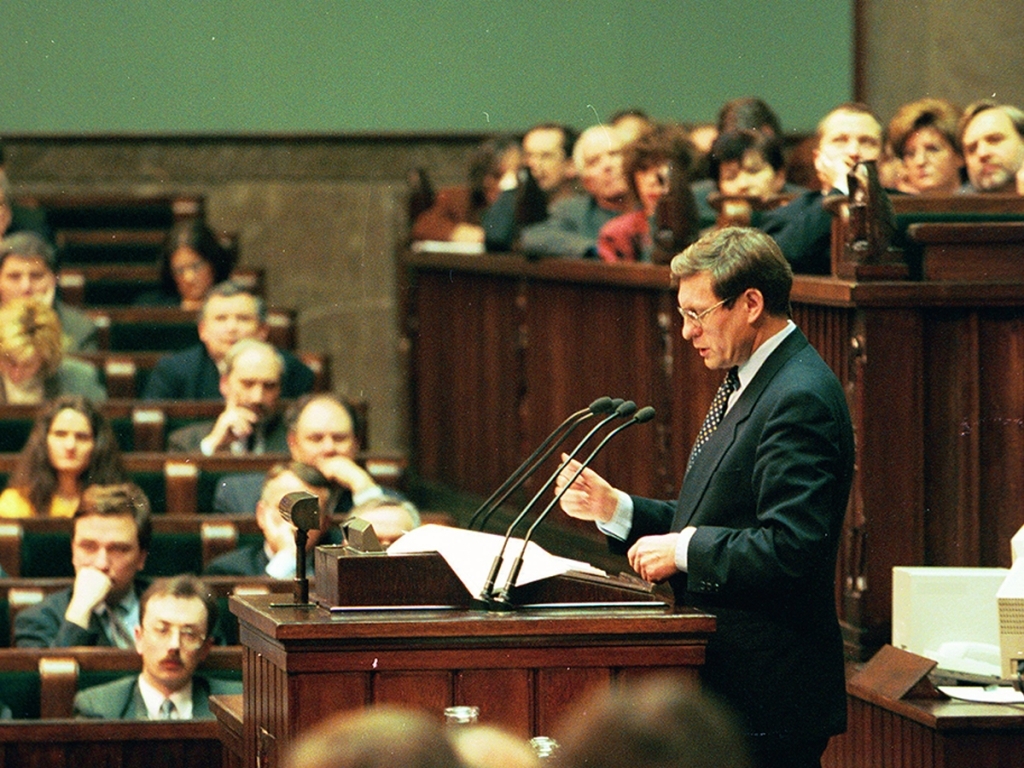
That changed with Poland’s democratic breakthrough in 1989. As Deputy Prime Minister and Minister of Finance in the country’s first non-communist government, Balcerowicz confronted a convergence of severe crises: hyperinflation, massive foreign debt, and the structural inefficiencies of a centrally planned economy. The scale and urgency of these challenges left little room for gradualism.
The reform program introduced between 1989 and 1991 was rapid, comprehensive, and, to many observers, unexpected. While policymakers in the West often anticipated a slower transition, Poland’s leadership moved decisively, convinced that swift and coherent action was essential to stabilize the economy and establish the foundations for sustainable growth. Balcerowicz has attributed the success of these reforms to rigorous analysis, the ability to make difficult and unpopular decisions, and the strength of the team assembled to implement them.
Balancing economic theory with political reality proved to be an ongoing challenge. Balcerowicz has consistently emphasized that meaningful reform inevitably encounters and that leadership requires resilience in the face of criticism. Necessary decisions, in his view, cannot be dictated by short-term public sentiment if long-term national interests are to be served.
His approach to reform was informed by years of comparative analysis of economic systems and a disciplined emphasis on logical reasoning. Balcerowicz has argued that reforms cannot rest on intuition alone; they must result from consistent and meticulous analysis. This analytical foundation helped him structure arguments, evaluate trade-offs, and avoid internal contradictions in policy design during periods of intense pressure.
Drawing on economic history, Balcerowicz has also cautioned business and policy leaders against overreliance on budget deficits and increased public spending as tools for sustainable growth. Such approaches, he has noted, often lead to long-term instability rather than durable prosperity.
The impact of these reforms reshaped Poland’s economic trajectory and influenced transition strategies across Central and Eastern Europe. Over time, Balcerowicz’s leadership earned international recognition, including Poland’s highest honor, the Order of the White Eagle, as well as prestigious economic awards named for Milton Friedman, Ludwig Erhard, and Friedrich von Hayek.
Warsaw, 6 October 1989. Leszek Balcerowicz, Minister of Finance in Tadeusz Mazowiecki’s government, presents to the Sejm a package of economic reforms later known as the Balcerowicz Plan.
Photo: PAP/Jan Bogacz
Looking Ahead
Now focused on teaching, research, and public discourse, Balcerowicz remains actively engaged with global economic trends. He has identified artificial intelligence as one of the most consequential forces shaping the coming decade, with significant implications for productivity and labor markets—while cautioning that, as with any new technology, not all current projections will prove accurate.
At the same time, he has expressed concern about the global resurgence of protectionism and policies that restrict free trade or weaken international cooperation. Such shifts, he argues, pose long-term risks to economic growth. Regionally, he has pointed to Latin America as an area with underappreciated potential, provided that populist economic policies can be durably reversed.
When asked what advice he would offer the next generation of business and policy leaders, Balcerowicz returns to a principle that has defined his career: people matter most. Selecting competent, honest collaborators committed to a shared mission, he believes, is the single most important determinant of lasting success.
From Queens to Warsaw, from the classroom to the cabinet table, Balcerowicz’s journey reflects the global reach of a Tobin education—and the enduring impact one Johnny can have on the world.
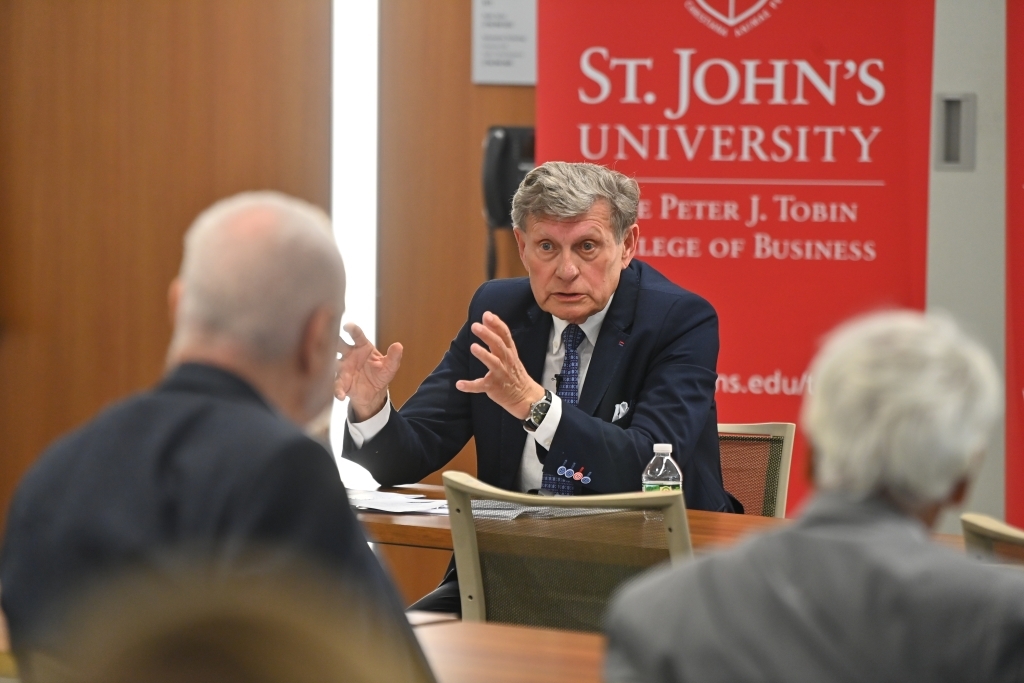
Leszek Balcerowicz returned to campus as the featured speaker for the Spring 2024 Henry George Lecture, becoming the first alumnus known to headline the series.
Professor Balcerowicz's Advice to Future Leaders
Q: What advice do you have for students entering business today?
Q: What advice do you have for students entering business today? A: Develop strong analytical skills and base your decisions on evidence and clear reasoning rather than on fashionable slogans or short-term trends.
Q: What characteristics will define the next generation of leaders? A: The leaders of the future will be defined by intellectual independence, resilience under pressure, and the ability to make difficult decisions with integrity.
Q: How should young business professionals think about global responsibility and ethical leadership? A: Ethical leadership means defending open markets, the rule of law, and individual freedom while resisting populism and short-termism in favor of long-term prosperity.
St. John’s University students had a unique opportunity to draw on the experiences of a former investment banking titan recently when Lloyd Blankfein , former Chairman and Chief Executive Officer (CEO...
Heather C. Robertson, Ph.D., LMHC, CASAC, CRC, Professor and Chair of the Counselor Education Department, has been selected as the 2026–2027 Scholar‑in‑Residence for the Center for Faculty Success and...
St. John’s University’s Maurice R. Greenberg School of Risk Management, Insurance and Actuarial Science, part of The Peter J. Tobin College of Business, will honor The Hartford’s Chairman and CEO...