
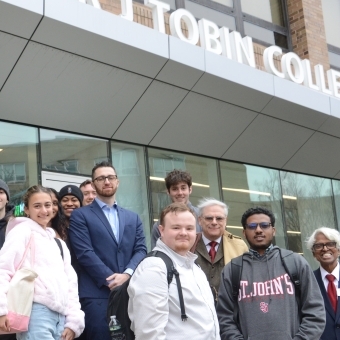
Improvements and Disruptions of AI and Supply Chain presented at St. John's

April 2, 2026
Supply Chain Lecture

An event, titled “AI Impact on Supply Chain: Improvement and Disruptions,” was held on Thursday, March 12th at St. John’s University in Queens, NY. Hosted by the University’s Management Department in collaboration with the Tobin Supply Chain Student Chapter, the seminar took place in the D’Angelo Center and brought together students eager to explore one of the most significant technological shifts in modern business. Organized by chapter leaders Rev. Haile Weldegiorgis and Swarsattie Mania, with faculty advisor Dr. Jay Nathan and sponsorship from the Tobin College of Business, the event provided attendees with direct access to industry expertise on the intersection of artificial intelligence, law, and global supply chains.

The discussion was led by two distinguished guest speakers from Falcon Rappaport & Berkman LLP. James M. Black II, a member of the firm’s Corporate & Securities Group, brought more than 35 years of experience in corporate compliance, government contracting, and trade regulation, including leadership roles at major organizations such as Northrop Grumman and CA Technologies. He was joined by Alexander Migliorini, an associate attorney specializing in corporate, digital assets, and taxation law, who combines his legal background with an MBA to help organizations navigate complex regulatory and technological environments. Together, they delivered a comprehensive and practical overview of both the opportunities and disruptions AI presents within supply chains.

Throughout the seminar, the speakers emphasized that while AI offers powerful tools to improve efficiency, it must be implemented thoughtfully and with human oversight. Reflecting on this point, student Joanna Saint-Fleur noted that the presenters highlighted how “the speed at which AI can help streamline supply chains is phenomenal,” while also stressing that “a human touch is always necessary” to ensure systems remain effective and accountable.

Legal and regulatory considerations were a major focus of the discussion. Student Michael DeJesus, reflecting on the speakers’ insights, explained that companies must be proactive in ensuring “vendors and independent contractors comply with not using AI” in ways that violate policy. He also noted that the speakers suggested AI regulation may develop more prominently at the state level rather than federally.

Issues of confidentiality and data protection were also explored in depth. Student Sean Kenny shared that the presenters discussed how “AI recording or note-taking platforms” can be treated as third parties, potentially compromising confidentiality. He further reflected on their point that new laws will likely emerge to detect and restrict AI usage, particularly in legal contexts.

Student Ivar Na Aga emphasized the importance of careful data handling, explaining that the speakers made clear how using AI with sensitive client information “can breach contracts” and create significant professional risks. This reinforced the need for caution when integrating AI into business processes involving confidential data.

From a liability standpoint, student Kaylee Sprizzo reflected on the speakers’ discussion of how generative AI can introduce unexpected risks. She noted that the presenters explained how AI systems may reuse confidential input data, potentially violate copyrights or trademarks, and even generate incorrect information—factors that collectively create “much more liability than thought of before.”

Student Swarsattie Mania pointed to the broader conversation around data transparency and consumer trust. Reflecting on the panel’s discussion, she explained that the speakers emphasized concerns about third-party data sales, tracking practices, and unclear use of cookies. These practices, she noted, have already contributed to legal challenges and growing public demand for transparency, reinforcing the idea that companies must clearly communicate what data is being collected and why.

Adding to these reflections, student Rev. Haile Suba Weldegiorgis, C.M., president of the Supply Chain Management Student Chapter, emphasized that the speakers framed AI not as something to resist, but as something to better understand and manage. Reflecting on the session, he noted that the discussion encouraged students to consider how organizations can responsibly integrate AI while maintaining strong information security and employee vigilance. He also highlighted the high level of student engagement, with attendees asking thoughtful questions focused on practical strategies for managing risk rather than dismissing the technology altogether.

Overall, the seminar provided attendees with a comprehensive understanding of both the benefits and the risks associated with AI in supply chains. By combining expert insight with student reflections, the event underscored the importance of responsible AI adoption—grounded in oversight, legal awareness, and transparency—as organizations continue to navigate an increasingly complex technological landscape.


Related News