
AI and Entrepreneurship Lessons I Brought Home From My Study Abroad Trip
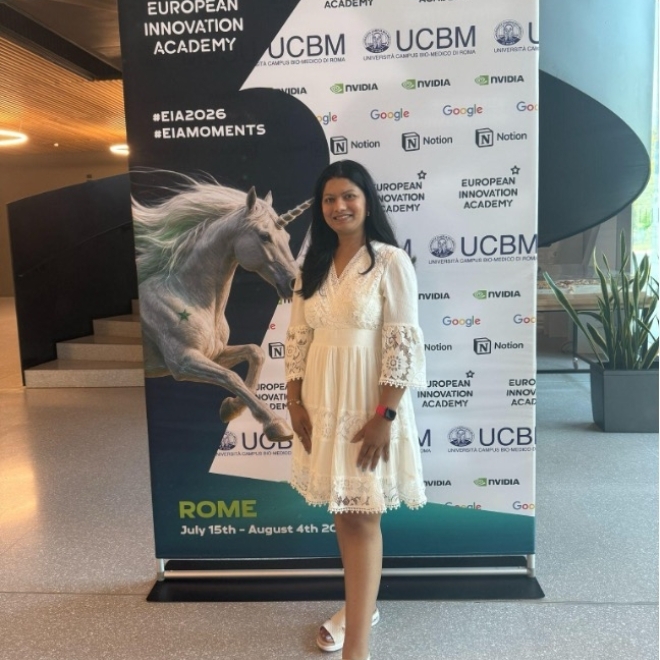
Rome Was My Classroom is a six-part blog series about my two-week study abroad experience in Rome, Italy, as a doctoral student at St. John's University and the lessons I brought home.
In Part 3, I shared how my team built a sustainable makeup brush startup and placed in the top 3 at the European Innovation Academy (EIA) 2026. This part covers what that experience taught me.
Building a startup at the European Innovation Academy taught me that artificial intelligence (AI) can help a small team research, build, and market faster than ever—but only when you give it real evidence and keep human judgment in charge. It also taught me to question my own ideas, listen to customers, launch before feeling ready, and tell a story people care about. The thread running through all of it is curiosity.
Here are nine AI and entrepreneurship lessons I brought home with me.
1. Don’t Fall in Love with Your Idea.
This may be the lesson I will remember most. When you create something, it’s natural to become emotionally invested. You begin defending the solution instead of investigating whether it is actually the right one.
I learned to become more comfortable being my own critic. Instead of asking only “How can we make this idea work?” I began asking, “Are we solving an existing problem, and what evidence do we have?”
2. AI Can Accelerate Entrepreneurship, but It Can’t Replace Judgment.
AI tools made it possible to move rapidly through research, ideation, early product thinking, content, analysis, and presentation development.
But speed creates another responsibility. Someone still has to decide whether the information makes sense, whether the customer insight is meaningful, whether the problem is worth solving, and whether the output actually serves a human need.
AI can accelerate the work. It doesn’t remove the need to think.
3. Give AI Your Evidence, Not Your Assumptions.
AI can produce a customer persona, value proposition, or pricing idea in seconds, and it will sound convincing even when it’s built on nothing but guesses.
The output is only as good as what you put in. Real customer conversations, like our 43 interviews (see part 3), give AI something true to work with: the words customers use, what they already buy, and what they’d pay. Start with evidence, then use AI to organize, summarize, and draft from it. Don’t ask it to imagine a customer you haven’t met.
4. Customers Help Build Better Products.
Our initial assumptions gave us somewhere to begin, but conversations with potential users helped determine where we should go next.
This required listening without immediately defending what we’d already created. Feedback wasn’t always confirmation. Sometimes, the most valuable feedback showed us where our thinking needed to change.
5. Use AI to Build Just Enough to Learn.
Perfecting something feels productive, but if nobody outside your team has used it, you may just be perfecting an assumption.
Building a minimum viable product (MVP) taught me to ask: What’s the smallest thing we can create that will teach us something meaningful? AI tools make that question easier to act on. With Figma and Lovable, a small student team could put a prototype and a website in front of people quickly, without a development team or design agency.
6. Commit to a Version Instead of Perfecting It.
On day 1, there was a keynote session from Robert Hucks, one of the mentors at EIA and an independent consultant in Silicon Valley. He quoted the Founder of Linkedin and the importance of why committing to a version is more valuable than perfecting it.
“If you’re not embarrassed by the first version of your product, you’ve launched too late.”—Reid Hoffman, Founder of LinkedIn
7. Write for AI Answers as Well as Search Results.
Customers no longer discover products only through search results. More of them ask AI assistants for recommendations, so being discoverable now means being easy for AI to understand and cite.
That changes how you write about a product from day one. State plainly who it’s for, what problem it solves, and what makes it different. Use the words your customers use, and answer the questions they actually ask. Clear, specific, evidence-based content works for people and AI alike.
8. Build Conscious Products.
On the last day, Alar Kolk, President of the European Innovation Academy, led a session on how to build conscious products. For our team, this landed close to home. Our brush began with a question about makeup-related waste. Honestly, the session could have opened the program because it reframes every decision before it. Still, better late than never.
9. The Lesson Behind the Lessons: Curiosity.
Looking back, the common thread connecting these lessons is curiosity.
Are we solving the right problem? What are customers telling us? What are they not telling us? What assumptions are we making? What evidence would change our minds? What can we test instead of debate?
Those questions aren’t useful only for entrepreneurs. I can bring them back to my work, doctoral studies, creative projects, and almost any situation where the first answer may not be the best one.
But some of the most important things I brought home from Rome weren’t entrepreneurship lessons at all. They came from the friendships, games, conversations, walks, meals, and small moments that happened between everything on the schedule. Those are the things no syllabus could have fully planned.
Next in the series: Rome Was My Classroom, Part 5: 7 Things Study Abroad Taught Me That Weren’t on the Syllabus.
Frequently Asked Questions
Which AI tools did you use at the European Innovation Academy?
EIA introduced us to a stack of AI and digital tools, including Figma for design and Lovable for building our website and digital experience.
Can AI replace the work of an entrepreneur?
No. In my experience, AI sped up research, design, and content, but people still had to judge which problems mattered, which insights to trust, and whether the product served a real need.
What is an MVP?
A minimum viable product is the smallest version of a product that lets you learn something meaningful from real users.
Is EIA only for business students?
No. I’m a doctoral student in multi-sector communication, and the lessons apply across fields.
How can St. John’s students attend the European Innovation Academy?
Watch for the St. John’s application in early spring 2027, and ask about funding. I attended on a scholarship from The Lesley H. and William L. Collins College of Professional Studies, as I describe inPart 1.
Thinking about studying abroad?
The St. John’s application to attend the European Innovation Academy in Rome opens in early spring 2027. Start withStudy Abroad and Global Programs, learn about theGlobal Passport andstudy abroad finances, and see how student founders pitch at St. John’sannual business plan competition.
Related Blog Posts
Seven Things Experiential Learning Taught Me While Studying Abroad
Rome Was My Classroom is a six-part series about my study abroad experience and the lessons I brought home from two weeks in Rome, Italy.
Six Time Management Hacks That Helped Me Master My First Semester
Between lectures, endless assignments, and trying to maintain an active social life, my early semesters felt like a constant fire drill. I was always reacting to deadlines at the last minute, running on low energy, and feeling overwhelmed.
As a St. John’s University doctoral student, working professional, and mom, I needed a plan that could work in real life—not just on paper. Over time, I realized working harder wasn’t the solution—I needed to change how I managed my time. I needed to change how I approached my schedule and make more intentional decisions.
Here are the six time management secrets I applied to master my semester and how you can do the same.

Diana Tachie-Mensah’s First-Gen Journey
Meet Diana Baaba Nhyirah Tachie-Mensah ‘26TCB, a first-year graduate student in accounting at St. John’s University. Through her experiences balancing work, graduate studies, and supporting her family, Diana reflects on the responsibility she feels to make the most of her opportunities and the importance of finding a community that understands her first-gen journey.

Geo Flores Peralta’s First-Gen Journey
Meet Geo Flores Peralta, a senior majoring in biology at St. John’s University. As a first-generation Mexican American college student, Geo has learned to advocate for himself, navigate unfamiliar experiences, and challenge expectations about what is possible for his future.

Keiry Diplan Beltre’s First-Gen Journey
Meet Keiry Diplan Beltre, a first-year nursing student at St. John’s University whose college journey is deeply connected to her family’s story. Having immigrated from the Dominican Republic at age five, Keiry sees pursuing higher education as an opportunity to honor her parents’ sacrifices, build a brighter future, and make the most of the opportunities they worked hard to provide.