From Graduate Student to Internal Auditing: Career Insights from a St. John’s Graduate Working at Meta

Bella Wang'15M.S. graduated from St. John's University with a master’s degree in accounting with a concentration in internal auditing. Now, she’s a System Manager Revenue Controllership at Meta. In this Q&A, she shares more about her journey into the field of internal auditing, what her days actually look like, and what she would tell a student who has no idea what any of this means yet.
Q&A with Bella Wang'15M.S.
Q: What first drew you to the Internal Auditing program at St. John’s, and was this always the career path you imagined for yourself?
Internal Audit was not really on my radar until I took “Audit 101” and an IT Audit course with David Y. Chan, Ph.D. The Internal Auditing program completely changed my perspective by shifting the focus from simply recording numbers to questioning how systems actually work.
I found it fascinating to look at a business process and identify gaps or risks that others might miss. Looking back, it’s funny because what started as an elective ultimately defined my entire career path.
Q: Looking back on your time at St. John’s, were there particular classes, professors, internships, or experiences that helped shape your career direction?
Dr. Chan had a profound impact on my career trajectory in internal auditing. He is a true advocate for his students and the profession itself.
He played a major role in helping students launch the Internal Audit Student Organization (IASO), which became an important connection point between the classroom and the professional world. Through the organization, students were connected with recruiters, internships, and full-time opportunities.
He also helped me realize that the career possibilities within internal audit were far broader than I initially imagined.
Q: How did the Internal Auditing program help prepare you for the professional world?
The program provided a strong theoretical foundation, but the most valuable part for me was the real-world case studies. We were constantly challenged to think critically about risks; ask “what could go wrong?”; and develop mitigation strategies.
That type of training sharpened my analytical thinking and prepared me for the practical side of the profession. The networking opportunities through IASO and the business school also helped me strengthen communication and interpersonal skills, which are incredibly important in internal audit.
In this field, your ability to communicate and build relationships is just as important as your analytical skills.
Q: What was the transition from college to your first role in the field like, and did anything surprise you?
The transition was smoother than I expected, but one thing surprised me right away: internal audit is extremely people-focused.
A large part of the role involves stakeholder management and building trust with teams across an organization. As a non-native English speaker, this became an advantage, pushing me to communicate with clarity and intention.
In internal audit, clear communication is the foundation of credibility. By being thoughtful and precise in my interactions, I was able to build trust and demonstrate professionalism early in my career.
Q: For students who may not know what internal auditing looks like day to day, what does a typical day in your role involve?
Over the last decade, I have worked across all three lines of defense, starting as an in-house auditor, then moving into Risk Advisory at Deloitte, and now working at Meta in the first line, designing and implementing controls.
A typical day revolves around two questions: What is the risk, and do we have the right controls in place to mitigate it?
That means collaborating with engineers, accountants, and business teams to better understand their processes. I also spend time learning how to integrate artificial intelligence into audit work by automating control monitoring and improving audit design.
Every day combines risk assessment, collaboration, and emerging technology.
Q: What do you enjoy most about working in this field, and what are some aspects of the job people might not expect?
The best part about an internal audit is that there is never a dull moment. You gain visibility into nearly every area of a business, from procurement and inventory to revenue and operations. Even after 10 years, I still learn something new every day.
I also enjoy the variety of people I work with. The role constantly brings you into conversations with smart, innovative professionals across different departments.
Many people assume auditing is repetitive, but in reality, it is an evolving field that requires continuous learning and adaptability.
Q: What advice would you give to a St. John’s student considering internal auditing?
My advice is to learn how to utilize artificial intelligence and automation tools as early as possible. The profession is evolving rapidly, and internal audit will likely look very different within the next five years.
Take the time to understand how these tools actually work through platforms like Coursera or specialized training programs. Companies are increasingly looking for professionals who can combine audit knowledge with technology and automation skills. The students who stand out will be the ones who can bridge the gap between traditional auditing and modern technology.
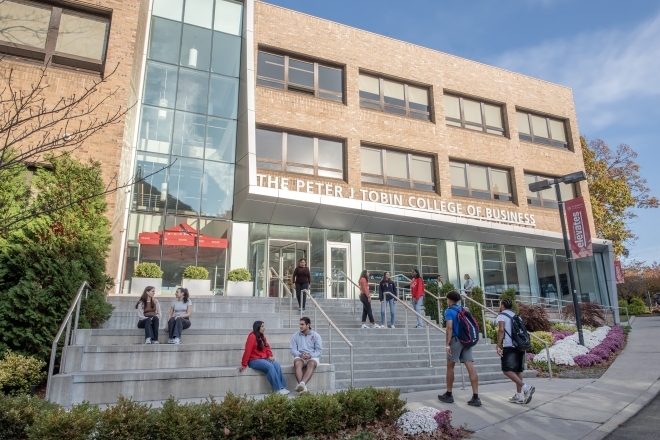
Interested in a career in internal audit and risk management?
The Risk and Financial Advisory M.S. program at St. John’s University equips students with the technical expertise, analytical thinking, and hands-on experience needed to succeed in today’s evolving business environment. Explore career opportunities in risk advisory, internal auditing, fraud examination, and enterprise risk management through the Risk and Financial Advisory M.S. program.
Related Blog Posts
A Leap of Faith: From Romania to St. John’s and Beyond
From Romania to St. John’s, international student Adina Stancu shares how her leap of faith opened the door to a college experience filled with global opportunities, meaningful connections, and a life she once never imagined.

Getting Involved on Campus: Finding Community and Confidence at St. John’s
Starting college can feel overwhelming. A St. John’s University student shares how getting involved helped her find her place, build confidence, and feel at home on campus.
