From Graduate Student to the Big Four Accounting Firm: a Conversation with Vas Vlahos ’20TCB, ’21M.S.
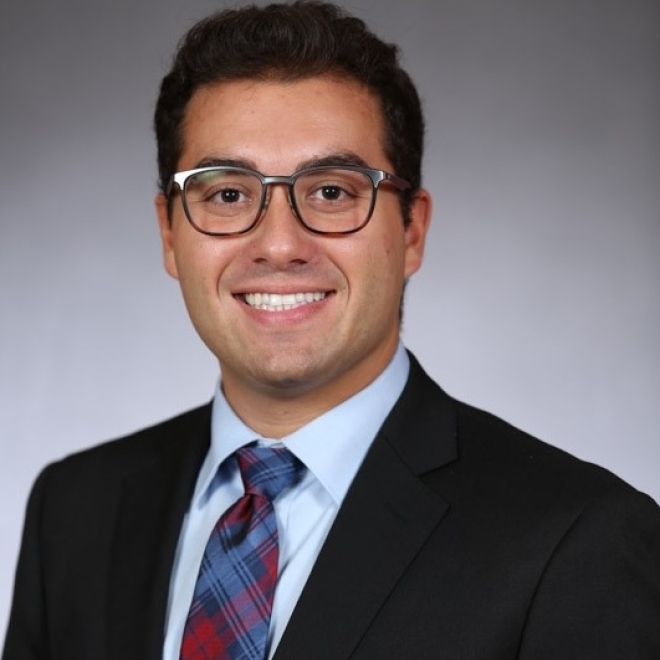
Vas Vlahos ’20TCB, ’21M.S. graduated from St. John’s University with a master’s degree in risk and financial advisory. Now, he’s a Senior Risk Consultant at Ernst & Young (EY). In this Q&A, he shares more about his journey into the field of internal auditing; what it actually looks like day-to-day; and what he’d tell a student who has no idea what any of this means yet.
Q&A with Vas Vlahos ’20TCB, ’21M.S.
Q: Did you come to St. John’s wanting to pursue an internal auditing career?
I didn’t know internal auditing was a career path until I met with Professor David Y. Chan, Ph.D. He explained the Risk and Financial Advisory (RFA) program and described internal audit as this “third area of accounting.” I was intrigued.
After a few classes at St. John’s, I realized I genuinely wasn’t interested in working in tax and external audit. I wanted something a little different, so I decided to go the route of risk advisory and internal audit—and never looked back.
Q: From a higher level, can you explain what an internal auditor does?
I get this constantly. I like to keep it simple: we help companies and executives ensure their businesses are running as effectively as possible while mitigating fraud and risk. Compare that to an external audit, which reviews financials and ensures they reconcile to a certain degree.
Q: How did the St. John’s internal auditing coursework prepare you for your first role out of college?
Internal Audit with Dr. Chan; Enterprise Risk Management with Paul L. Walker, Ph.D.; and Fraud Examination with Joseph E. Trainor, Ph.D., were the big ones. Dr. Trainer’s class specifically helped me realize I didn’t want to pursue a career in external auditing, so, in that sense, it helped me make a decision, even if it wasn’t pointing me in a forward direction.
Public speaking was also one of the most instrumental courses I took, even though it had nothing to do with my career path. I’m a nervous speaker, but that class gave me a foundation for conveying a point to an audience. And once you have that, you can sell anything.
Q: What soft skills matter most in this field?
Communication is the most critical because it’s not just about conveying what you’re doing; it’s how you build trust.
If you’re not communicating with your team, you can’t build trust. If you don’t have trust, you don’t have a good working relationship. If you don’t have a good working relationship, you don’t have work. I tell the people I manage: it’s okay if you’re running behind or running into problems. Tell me, and I will help you figure it out. But if you don’t tell me, I won’t know, and my expectation is what I communicated to you. It’s a two-way street.
Q: What does a “day in the life” actually look like for you?
This is always a tough question, because the work is broad and shifts based on the engagement you’re on and the phase of the project.
Take a SOX 404 audit, for example. Early on, we’re performing walkthroughs, going to the client, and documenting how their processes work. Then we move into testing those controls with a larger sample size. Then we repeat at year-end and close everything out in December or January. In a senior role, my day is largely answering questions, following up with clients, and managing my onshore and offshore team to make sure workloads are balanced. If something comes up I can’t answer, I escalate to my manager. Anything beyond that is specific to the client.
Q: What’s your take on artificial intelligence (AI) and where it fits in this field?
AI is the direction all of our fields are heading, and if you can leverage it from the start, it just sets you up for additional success. That said, I recently participated in an AI training where I used AI to complete a task alongside someone else in my group. Same worksheet, same questions. We got completely different results. During the debrief, I brought it up, and this is the point I made: AI is not ready to take over our jobs because you still need someone with experience to look at the output and apply judgment based on the scenario. A good AI prompt is a skill. Knowing what to do with the result is even more valuable.
Q: Any advice for a student who’s considering this field?
Just go for it. In my experience, people end up in internal audit because external audit didn’t speak to them, and they have a genuine desire to help people develop, grow, and make sure things work efficiently. That’s how I sold myself on it, too. I knew I had a desire to help people and make sure things are operating as they should. There hasn’t been a day I was bored. I’m always learning and it’s always different.

Interested in a career in internal audit and risk management?
The Risk and Financial Advisory M.S. program at St. John’s University equips students with the technical expertise, analytical thinking, and hands-on experience needed to succeed in today’s evolving business environment. Explore career opportunities in risk advisory, internal auditing, fraud examination, and enterprise risk management through the Risk and Financial Advisory M.S. program.
Related Blog Posts
A Leap of Faith: From Romania to St. John’s and Beyond
From Romania to St. John’s, international student Adina Stancu shares how her leap of faith opened the door to a college experience filled with global opportunities, meaningful connections, and a life she once never imagined.

Getting Involved on Campus: Finding Community and Confidence at St. John’s
Starting college can feel overwhelming. A St. John’s University student shares how getting involved helped her find her place, build confidence, and feel at home on campus.
