
Meet the 2025–2027 AI Faculty Fellows
Dr. June Chen, School of Education
Dr. Christoforos Christoforou, Collins College of Professional Studies
Dr. Fazel Keshtkar, Collins College of Professional Studies
About the AI Faculty Fellowship
The AI Faculty Fellowship supports innovative projects that deepen the University’s engagement with artificial intelligence and its role across academic disciplines. The goals of the Fellowship are to:
- Strengthen St. John’s position as a leader in shaping the role of AI in higher education and society
- Accelerate interdisciplinary AI research and scholarship
- Enhance teaching, learning, and student engagement through thoughtful AI integration
- Promote ethical, responsible, and inclusive approaches to AI
- Advance priority themes including sustainable and ethical use of generative AI in pedagogy, Growth of AI‑driven research at St. John’s, and Mission‑aligned AI initiatives supporting students at risk
AI Fellowship Research Highlights
AI Fellowship Project: AI Tutor: Ethical and Adaptive Generative AI for Equitable Learning and Workforce Readiness
Research Foundation: My fellowship builds on our existing AI tutoring platform, CodifyAI (https://codifyai.org/), and previous NSF-funded I-Corps research on AI applications in education.
Research Focus: The project investigates how generative AI and large language models can provide personalized, adaptive, and explainable tutoring while addressing fairness, accessibility, and responsible AI use.
Educational Evaluation: We are conducting ongoing evaluations of CodifyAI, examining the quality of AI-generated feedback, student learning experiences, and the effectiveness of AI-assisted tutoring.
Student Research: Our research involves undergraduate and graduate students. One ongoing master's thesis investigates how AI tutors can adapt their feedback to different learners using the SOLO taxonomy, a framework for evaluating levels of understanding.
Fellowship Goals: Through the fellowship, we aim to advance adaptive AI tutoring, evaluate its educational impact, and explore opportunities to integrate responsible AI technologies into university courses.
"My research aligns with St. John's commitment to AI innovation by exploring how emerging technologies can improve teaching and learning while keeping students and faculty at the center. Through this fellowship, we aim to develop more personalized, ethical, and accessible AI tutoring systems that support student success and equitable learning opportunities. Equally important, the project creates opportunities for students to participate directly in AI research and contribute to responsible technological innovation."
"My research explores the intersection of artificial intelligence and neuroscience, with a focus on developing adaptive generative AI systems informed by human neural activity. Through this project, I am advancing a novel neural-congruency framework by integrating deep learning, multimodal foundation models, and EEG-based brain signals to investigate new forms of human-AI interaction, cognitive engagement analysis, and brain-generated content. At the same time, I am developing practical AI tools that allow faculty and students to easily create and use AI agents in teaching and research. By combining practical AI innovation with fundamental research, this work seeks to expand the accessibility of AI technologies while advancing scientific understanding of intelligent systems and their relationship to human cognition."
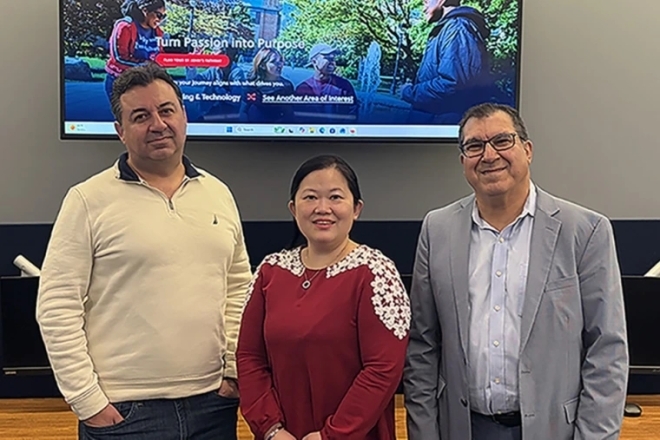
St. John’s Names Three Inaugural AI Faculty Fellows
St. John’s University has named three faculty members as its inaugural AI Faculty Fellows: Xiaojun Chen, Ph.D., Christoforos Christoforou, Ph.D., and Fazel Keshtkar, Ph.D. The initiative promotes AI research, interdisciplinary collaboration, and the ethical integration of AI into teaching and learning, with a focus on improving student success through innovative, personalized, and accessible educational tools.