
Thought Experiment: AI in Warfare
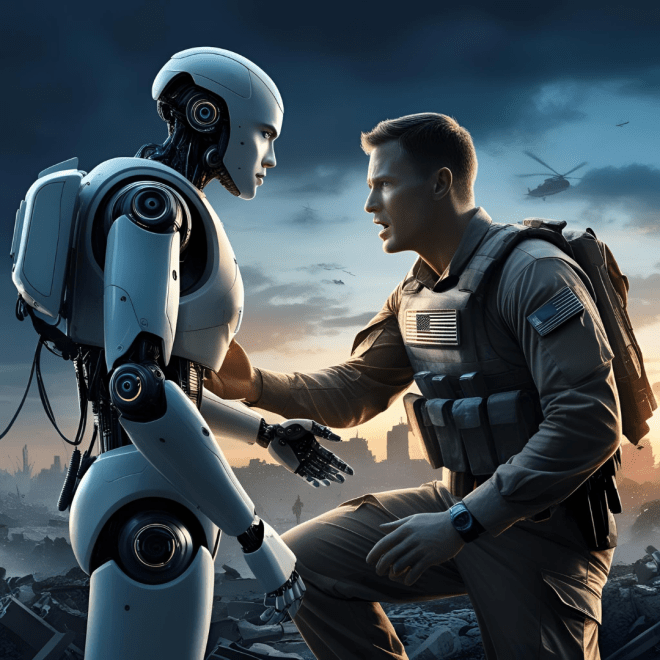
Read the rising role of artificial intelligence in warfare, and why students at St. John’s University in Queens, NY, feel global regulation is needed.
The Growing Role of Artificial Intelligence in Warfare
As a graduate student in the Master of Science in International Communication degree program at St. John’s University, I have engaged in several thought-provoking discussions on the integration of artificial intelligence (AI) into contemporary society and the plausible outcomes that may result from this technological shift.
I ponder how this tool may be used for harm on an intercontinental level. Indeed, it is quite a grim thought to have about a thriving technology that has brought both countless good and harm for humans, but it is important that this matter is discussed so that one may infer as to how it may be alleviated.
Seeing that the use of machines and computerized systems has become more prevalent in warfare tactics—an example being the use of drones in the Russia v. Ukraine conflict—it is hardly a fantasy to assume that AI may come to play a crucial role in future conflicts. Whether it be an arms war where nations compete to create the most enhanced AI in existence, or even the deployment of this technology to attack soldiers through unimaginable means, this is a conversation that must be addressed so that proper regulations and limitations are placed for the sake of humanity’s well-being.
A New Era of Military Competition
First, there has already been rising competition among nations in a race toward AI development.
Consider the recent shift in technological balance caused by China’s new AI chatbot “DeepSeek.” This newly released artificial intelligence single-handedly put OpenAI’s ChatGPT in jeopardy due to its open-source nature and high intelligence offered to all users for free.
Subsequently, the stock prices of major tech companies in the US dropped, and they only recovered months later. This alone showcases potential future concerns regarding how this heated tension may grow into a full arms race between major world powers, with patterns being similar to those of the Cold War between the United States and the Soviet Union.
The Use of AI in Modern Combat and Drone Warfare
Beyond this, one might also consider the usage of AI in warfare, particularly psychological warfare. Yes, it is likely that the military will opt to use AI in manners such as controlling combat vehicles or landing drone strikes as these practices require a high level of calculation and coordination that will be capable of by AI.
Furthermore, it is cost-effective and less harmful to human lives if machines were to be used in warfare instead. However, the argument that human casualties are necessary in war remains to be discussed.
The Threat of A.I.-Driven Psychological Warfare
What should be feared, however, is the employment of AI in harming the morale or mental stability of enemy soldiers. It is simply frightening to imagine a possibility where AI is trained to psychologically attack its targets, whether it be through emotional manipulation or perhaps even in interrogations of criminals.
While it is doubtful that artificial intelligence is able to do such deeds at this very moment, technology will eventually be more than capable of doing it at the rate that it is growing.
Explore the Future of Global Communication with St. John’s
If questions like these spark your curiosity—how will technology shape our world, and what role do we play in that future?—then a master’s degree (M.S.) in International Communication at St. John’s University might be the next step.
This program invites students to dive deeper into the global issues we debate in class, from digital diplomacy to ethical tech development. It’s a space where critical thinking meets real-world application—and where curiosity can evolve into meaningful impact.
Master’s degree (M.S.) in International Communication
Related Blog Posts

How AI Is Changing Finance: a Q&A with Yun Zhu, Ph.D.
Finance has always been driven by data, but artificial intelligence (AI) is changing who can analyze it, how quickly, and what questions are even worth asking.

Students Share the Decisions That Changed Their College Experience
College isn’t defined by one big decision. Often, it’s the smaller choices—like joining a club, saying yes to a mentor, entering a competition, or pursuing an idea—that shape your experience in meaningful ways.
We asked four St. John’s University students to reflect on one decision they would make again, and their answers may inspire your own college journey.