
Remembering September 11: The Strength of the St. John’s Community
Everyone who was in New York City on September 11, 2001, remembers how the day started. It was a beautiful, cloudless, comfortable, late summer day with an impossibly blue sky.
I was in my second year as a writer for St. John’s University in the Office of External Affairs. A proud alumnus, I was happy to be “home” eight years after graduation.
As was my custom, I arrived at work far earlier than necessary. I enjoyed getting a great parking spot and easing into my day, rather than experiencing the last-minute crush of those trying to beat the clock, even if, truth be told, no one was watching.
At around 8:30 I called a friend whom I was meeting in Manhattan later that day. We had free tickets for a movie screening featuring the director and star and were making last-minute arrangements. I was scheduled to work half a day and planned to leave around lunch time.
A little more than 15 minutes into the conversation he told me that a plane had crashed into the World Trade Center. Like so many others, I assumed it was a small prop plane and didn’t really consider it could be anything worse than that.
I brought up CNN’s website on my computer. The first horrific image I saw was a still photo of the gaping hole left in the North Tower. I looked up from my desk and saw someone running past my office in a panic.
I passed the office of the media relations director. A crowd was quickly gathering around his television. I watched a replay of the second plane hitting the South Tower, which had occurred moments earlier. People who were not sitting in stunned silence were frantically calling loved ones who worked in lower Manhattan.
At the time, our office was housed in St. Vincent Hall, where the St. Vincent Health Sciences Center now stands. Anyone familiar with the campus knows the adjacent St. Vincent staircase provides the most scenic views of the Manhattan skyline.
Two colleagues and I ventured outside to witness with our own eyes the carnage we saw on television. That image is forever seared into my consciousness.
It was only a matter of time before the University closed and we were sent home. As I drove east on Union Turnpike, legions of firefighters waited at public bus stops to work at the site quickly renamed Ground Zero. That also remains a potent memory.
The Response
In the days that followed, my role gave me another vantage point from which to witness the aftermath.
The University mobilized an incredible response that included prayer services and candlelight vigils, counseling, and support—but there was an even more tangible effort that forever cemented and epitomized our relationship with New York City.
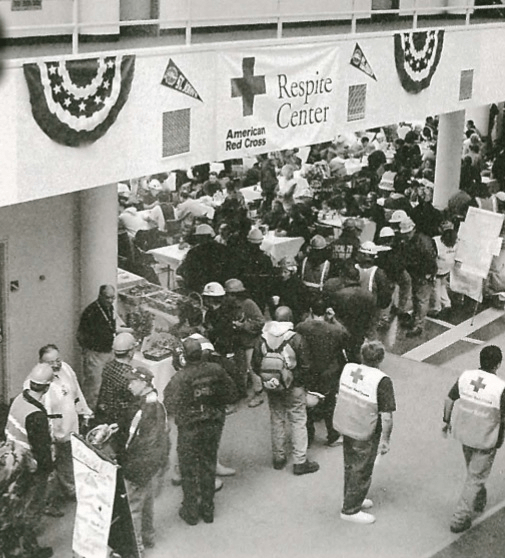
Upon merging with the former College of Insurance in May, 2001, the St. John’s University community celebrated the opening of its first campus in the heart of Manhattan’s financial district. Classes began a week before the attacks and there was a sense of excitement for the future. The events of September 11 immediately changed everyone’s focus.
After quickly situating hundreds of stranded Manhattan students on the Queens, NY, campus in an operation that can only be described as herculean, St. John’s invited the Red Cross to use the Manhattan campus (then located at 101 Murray Street) as its first-ever Respite Center in an effort to meet the needs of everyone working at Ground Zero, from police officers and firefighters to construction workers and the National Guard.
Declared safe for occupancy, the campus quickly became an oasis for countless workers who were selflessly giving their time and talent to clear away oceans of debris and attempt to recover the remains of everyone who was lost.
Along with several colleagues, I was invited to tour the facility.
The first thing I noticed was the expressions of those who worked at Ground Zero. After bearing witness to horrors no one should ever see, they possessed an otherworldly, distant look on their faces.
However, they soon realized this was a safe space where many of their needs would be met. This was a place of welcome and rejuvenation. More than 9,000 hot meals were served there each day.
I remember a large conference room was transformed into an all-purpose area outfitted with recliners, televisions, video games, and computer terminals. At any time, scores of workers contacted friends and relatives via email, watched the baseball playoffs, or closed their eyes for a quick nap.
There were massage therapists and a chiropractor on staff to ease the workers’ physical tension, as well as counselors present to attend to their emotional needs. Mass was celebrated each day.
On the second floor, several rooms were set aside as makeshift bedrooms. On the pillow of each bed were notes made by schoolchildren around the country thanking the workers for their efforts; teddy bears with thank-you cards adorned every nook and cranny of unused space.
One of the enduring lessons of September 11 was how quickly the best of humanity answered the worst.
A long-tenured colleague of mine recently said, “If I had to be somewhere that day, I’m glad it was at St. John’s.” She was able to spring into action and use the resources at her disposal to immediately start helping people.
I cannot believe 25 years have passed and that a generation exists with no memory of the attacks. It is for them and future generations that we record what happened—not simply for posterity, but to honor the sacrifice of everyone who made a difference, both on that day and in the months and years that followed.
Bearing witness to that sacrifice and sharing it with the wider world was a privilege for me because people needed to know that goodness, empathy, and fortitude did not die when the towers fell. In that moment, those ideals became stronger.
There are so many images embedded in my consciousness from that terrible day, but it’s the St. John’s response I choose to remember.
Related Blog Posts
What to Look for on a College Website: Nine Things to Check
A college website can tell you a lot more than how much tuition costs or when an application is due.
You can meet the professors you could learn from, discover research happening on campus, find scholarships you may be eligible for, explore internships and other hands-on opportunities, and see how current students are turning their college experiences into opportunities for the future.
As you research your college options, here are nine places on a university website worth clicking into.

A Leap of Faith: From Romania to St. John’s and Beyond
From Romania to St. John’s, international student Adina Stancu shares how her leap of faith opened the door to a college experience filled with global opportunities, meaningful connections, and a life she once never imagined.



College Brag Sheet: What It Is and What to Include (with Examples)
You have asked your teacher, counselor, or another mentor to write you a letter of recommendation. But, before they can start writing, they may ask you for something you have probably never heard of: a brag sheet.
Despite the name, a brag sheet is not about showing off. It is your opportunity to share the experiences, accomplishments, goals, and qualities that make you who you are.