
Earning a Marketing Degree in the Age of AI: A Conversation with Alexander J. Buoye, Ph.D.

Marketing is one of the fastest-moving fields in business, and artificial intelligence (AI) is at the center of that change. As a part of our “AI in the Classroom” Series with the Peter J. Tobin College of Business, we sat down with Alexander J. Buoye, Ph.D., Professor of Marketing, to talk about what that means for students entering the workforce, and how his classroom is already responding.
AI Is Already Reshaping Marketing
Why is AI fluency becoming essential for students entering marketing careers right now?
AI is at the forefront of almost everything in business at this point, especially in marketing. The job market our students will enter requires familiarity with these tools—how others are using them and the potential pitfalls of using them incorrectly.
Even for those who are skeptical or who have moral objections to using AI, it would be irresponsible not to engage with it—so, we must prepare our students.
And in marketing specifically—and even more specifically, digital marketing—AI is completely changing how we do our jobs. Search advertising is undergoing a major shift from traditional SEO to AEO and GEO. Even Google has incorporated AI overviews into Google Search. So business as usual is not an option.
Bringing AI Into the Classroom
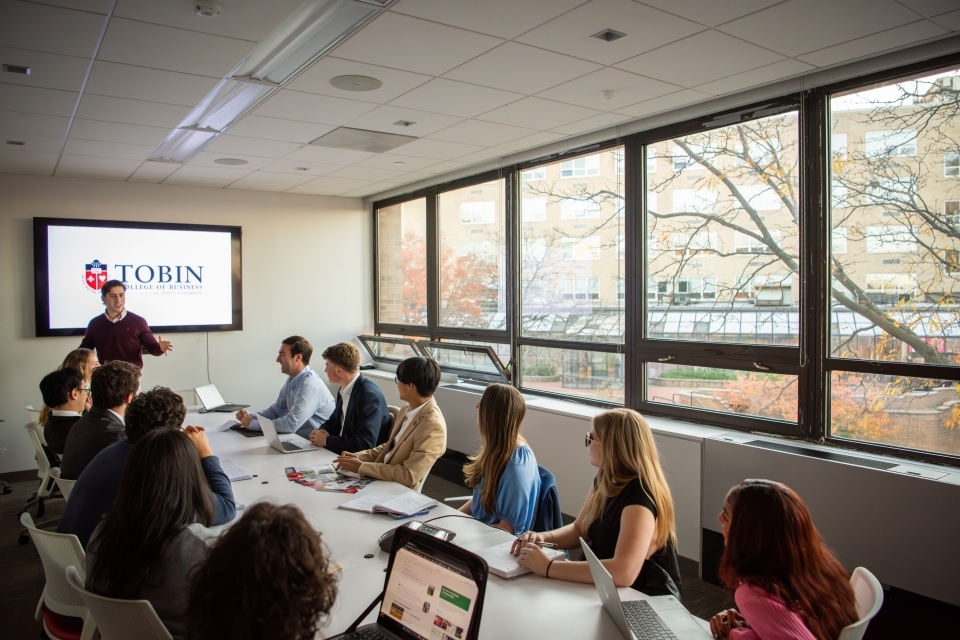
How are you bringing that into the classroom, and what will students take from it?
I was actually fortunate to receive two grants: one for AI innovation and another for experiential learning, and I am tying them together into a more unified project around AI.
The AI-focused grant is being used to improve my Direct Marketing Models class. I’ve been teaching a version of this course for several years, and it’s based on the predictive modeling techniques I learned during my career in direct mail marketing. We use statistical software to develop regression-based response models on real campaign data and then apply those models to external files to target the best prospects.
Some of my students initially question the value of this kind of “old school” methodology, but what I explain to them is that the mechanics are similar across all kinds of direct response marketing initiatives. If you try to translate this directly from direct mail to email, it feels odd, because we use direct mail models mostly to reduce printing and postal costs, and you don’t have any of that in email marketing. But the real parallel is paid social advertising—getting your message in front of the right people.
Impressions and clicks cost money. So if your models aren’t targeting the right people, you waste money and get worse results. That’s the connection. The techniques aren’t exactly the same, but the strategy is based on the same fundamentals. Model the outcome you want. How do you do that? You need data on that outcome. So how do we get a platform like Meta to target the right people? What kind of data do we need? Those are the questions an old-school understanding can help our students articulate answers to.
We’re not building models offline in SPSS anymore. We have Meta doing that work for us “under the hood.” But I need students to understand what the objective is, and not to treat platforms as black boxes that magically produce results. That hands-on work sets the stage. And this grant allows us to make the jump to where this modeling actually happens now—targeting social ads within the platform. That also means navigating new AI tools, which sometimes includes knowing when to shut them off.
With the second experiential learning grant, I’m applying this work in my Marketing Research seminar. Students conduct surveys comparing responses to AI-generated content versus human-generated content, and everything in between. It’s not really about whether to use AI or not, but when to use it and how much.
As students work with these tools and projects, what lessons or skills do you hope they leave with?
The point is that AI is impacting marketing practice on several levels. We’re not just talking about ChatGPT and writing copy, although that’s part of it. It’s system-level. It’s targeting. It’s the math, too.
Honestly, a few years ago, my thinking around AI pedagogy was more about how to create an AI marketing course to address students’ needs, and now that feels a bit passé. AI has to be part of everything we teach in marketing now. It’s part of every marketing class—how to leverage AI and how to be responsible with it.
Preparing Students for Today’s Business Environment
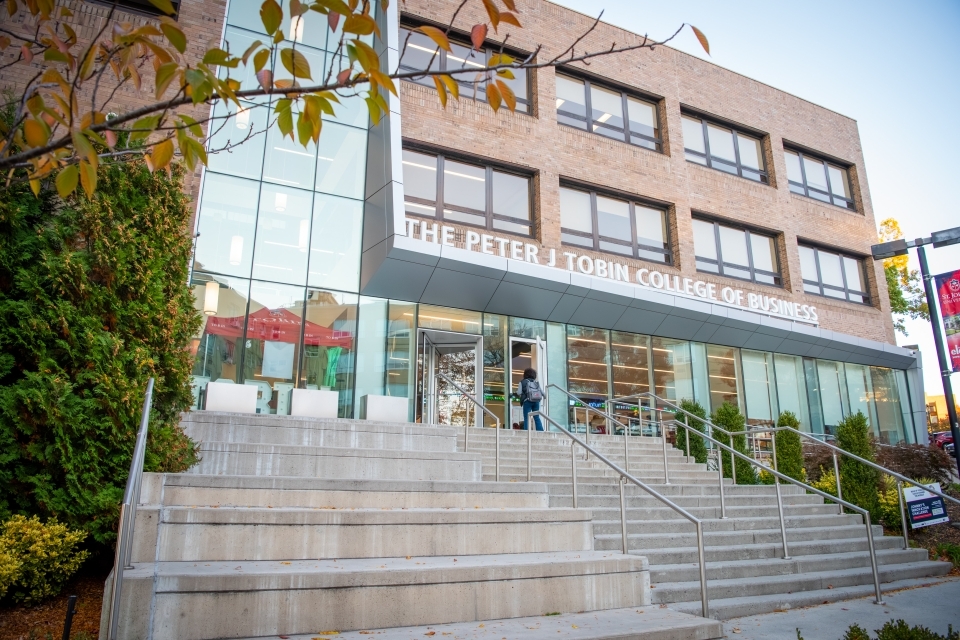
What does this say about what a Tobin marketing education looks like today?
It says that we recognize AI isn’t just part of the future of business education. It’s part of the present. It’s not something that’s coming; it’s already here.
And while there will be massive changes in an evolving technological and ethical landscape over the next few years, this isn’t tomorrow’s challenge. It’s today. Right now. We’re preparing our students to be competitive as soon as they graduate.
How do you see AI continuing to shape your field over the next five years, and how should today’s students prepare now?
Teaching digital marketing has really reinforced the old adage that the only constant is change. The digital marketing course I teach next fall will be very different from the one I taught last fall, because it has to be. I don’t have a crystal ball, but I know for certain that there will be changes.
Some will be on a more predictable scale, like Instagram’s algorithm updates. Others will be much more structural, like Google changing how buying ad space works when the goal is no longer reaching the top of the search engine results page but being mentioned in an AI-generated summary.
Specifically, I see platforms like Meta continuing to shift ad targeting away from human decisions and toward AI-driven optimization. The traditional model of segmenting audiences and creating different ads for each group is evolving into allowing platforms to generate and optimize creative across thousands of microsegments. In many cases, marketers need to give the platform room to learn and adapt rather than trying to control every step—and that can be uncomfortable for those of us who learned the more traditional approach.
That’s going to be a balancing act for marketers. I compare it to financial trading, where you have technical signals and fundamentals. You don’t want to rely too heavily on either in isolation. It’s about finding the right balance between those perspectives and tools, and that balance will shift depending on the situation.
The most valuable and successful businesspeople will be those who can discern when and where that balance needs to change. The ones who aren’t afraid of the tools, but also aren’t afraid to say when it’s not the right time to use them. That takes courage. And courage requires confidence. And confidence requires experience.
That’s what I try to provide in my classroom, and I’m grateful to Tobin for giving me that opportunity.
Learning How to Adapt
What do you want students to understand about learning in a field that never stops changing?
I’ve always said this about a college education: you don’t come here simply to learn the material, but to learn how to learn and adapt. This is not something you do for four years, and then you’re done. It’s a lifelong enterprise. There’s a reason I don’t refer to my marketing textbooks from the 1990s anymore—not because everything in there is wrong now, but because even what is still correct needs to be understood within the current context.
Related Blog Posts
A Leap of Faith: From Romania to St. John’s and Beyond
From Romania to St. John’s, international student Adina Stancu shares how her leap of faith opened the door to a college experience filled with global opportunities, meaningful connections, and a life she once never imagined.


Getting Involved on Campus: Finding Community and Confidence at St. John’s
Starting college can feel overwhelming. A St. John’s University student shares how getting involved helped her find her place, build confidence, and feel at home on campus.

How AI Is Changing Finance: a Q&A with Yun Zhu, Ph.D.
Finance has always been driven by data, but artificial intelligence (AI) is changing who can analyze it, how quickly, and what questions are even worth asking.

Students Share the Decisions That Changed Their College Experience
College isn’t defined by one big decision. Often, it’s the smaller choices—like joining a club, saying yes to a mentor, entering a competition, or pursuing an idea—that shape your experience in meaningful ways.
We asked four St. John’s University students to reflect on one decision they would make again, and their answers may inspire your own college journey.